Saturday, March 30, 2013

_
One morning in Florida, while Monica and the boys went to Disney's Hollywood Studios theme park, I went birdwatching.  I navigated the bus system to the landing at "Fort Wilderness," a campground that sprawls along Bay Lake.  As I walked east away from the complex with its stores and dining halls, and golf carts, I was alone on a sandy shore.  A turkey eyed me warily, but calmly.  Winter warblers were active in the shoreline shrubs, and grackles and red-winged blackbirds were contesting noisily in the reeds.  As I walked along, the reed mats were undulating calmly - or more violently if a boat had passed.  Coots swam and moorhens stalked.  A little blue heron stood motionless.  I came to a canal where a large red-bellied turtle sunned itself.  A bald eagle soared overhead among the vultures and ospreys.

I notice a Louisiana heron in the reeds -- called a tri-colored heron nowadays -- who suddenly hunkered down.  A commotion was working its way down the shoreline.  There were two dozen double breasted cormorants diving among a half dozen brown pelicans.  But it was the accompanying flock of herons that was making the ruckus.  A half dozen croaking great blue herons, two dozen white egrets, a handful of snowy egrets were flapping and fishing as they came.  I saw a white egret trying to fly with a large sunfish and find a stable spot to swallow the thrashing thing.  The blackbirds and grackles and belted kingfishers raised more noise.  The flocks passed by me to the swampy eastern end of the lake, where they rose up to the cypress or disappeared down into the reedy marshes.

I crossed the canal and passed a locked and abandoned cabin.  A hazy network of footpaths mazed through the undergrowth into a woods of cypress.  Swallowtail and zebra longwing butterflies searched for flowers.  I made my way along the shoreline.  Red bellied woodpeckers were pounding on the trees.  A cardinal came to check me out.  I pushed through the shrubs to the marshy shoreline, stepping back when I began to sink.   On a dead stump an anhinga spread her wings to dry.  An alligator hunted among the coots and pied billed grebes, but the birds didn't seem fooled by the gator's log-like demeanor.  A grebe swam alongside, a few feet away, until they both passed out of sight.  A barred owl was calling from somewhere behind me, "who cooks for you?  who cooks for you?" 

I retraced my path back out of the cypress and the butterflies and walked up along the canal.  Men were fishing there.  I made my way out to meet Monica and the boys for lunch.
_

Friday, March 29, 2013

_

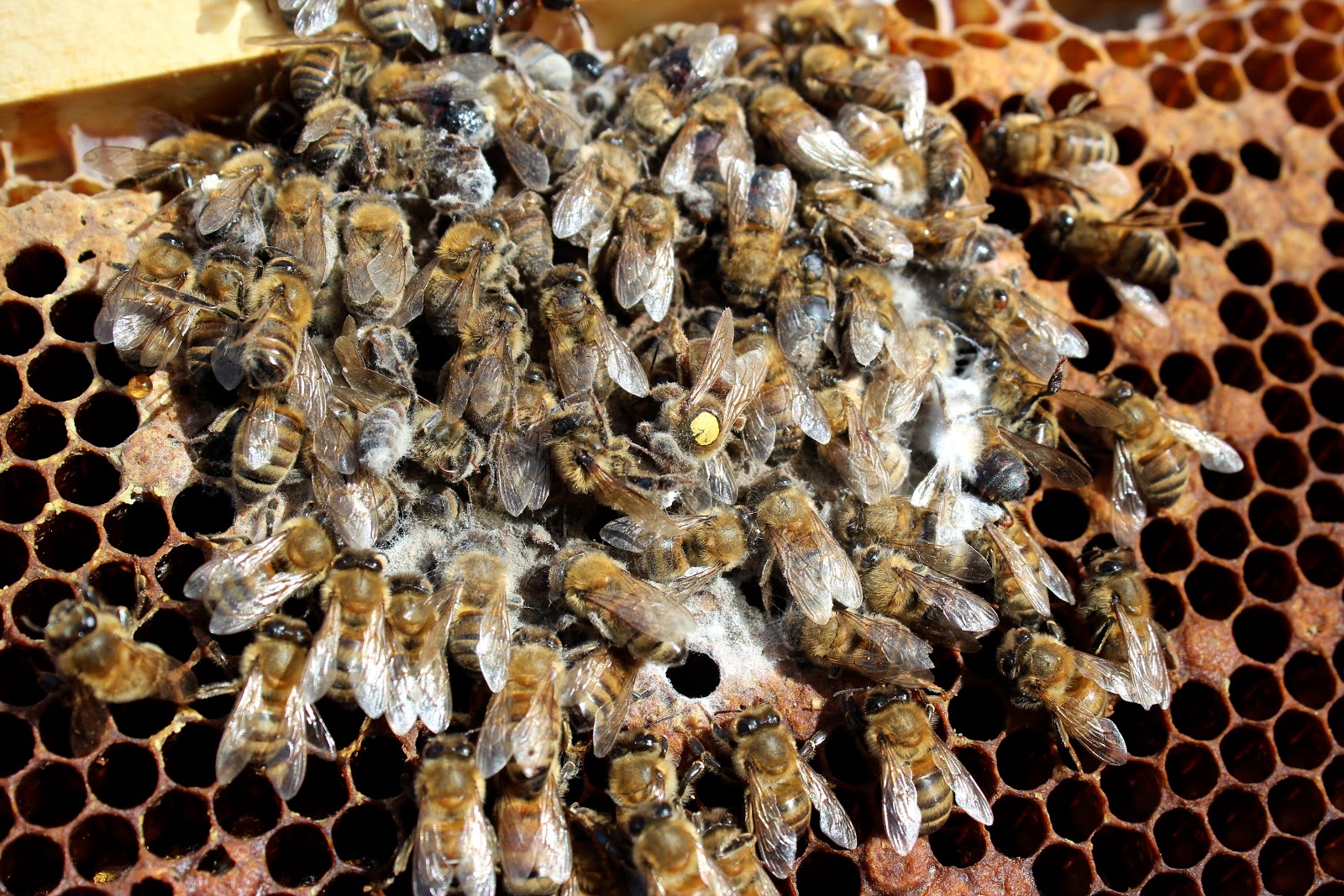
It's been a tough year for bees.  Colony collapse.  None of my three hives made it through the winter.  Two of them were abandoned before winter even set in.  The third was gone by the time I checked in February.    


The hive was three stories. The lower two were mostly cleared of honey, as you'd expect in a colony that is gradually consuming its winter stores.  The top story was full of capped honey.

I found the remains of the cluster -- a few dozen dead bees all gathered around the body of the queen.  (She's the one in the center marked with a dab of yellow paint.)

I can only guess that as the cluster dwindled, the bees couldn't maintain their heat and so they failed, freezing and starving where they were, just inches away from full combs.

A handful of bees were actually up in the honey comb, but just as dead.

There's a white mildew on them, but I think that came after.

I think this year's project on the beekeeping front will have to be learning how best to treat for mites and the other maladies that can weaken and kill a hive. 

The left-over honey I saved to feed to the new colonies that will be arriving in a few weeks.

Hope springs eternal.


Sunday, March 24, 2013

_
Rhubarb is emerging, bruised by the frost.

Choke cherry

A bluebird is vying with nuthatches for a weather-beaten old birdhouse.  

As the bluebird peers into the house, the nuthatches noisily complain from the nearest limbs.  They spread their wings and flare their tails and make quivering pirouettes.  

This enrages the bluebird, and he flies at them angrily. 

The chickadees, titmice, juncos and woodpeckers make up the raucous mob of bystanders egging them on.

Shoots are coming up in the frame of mixed greens I planted.  

Thursday, March 21, 2013

-
I've just returned from 4 days in Orlando in the belly of the Disney Beast.  Monica, who grew up in California, has an affection for Disneyland and its Florida sistren.  She spared me the details, but she got some sort of a deal on a full package, and was taking the boys to Orlando for four days during their spring break.  Being of a more cynical bent when it comes to the Disney empire, I was meant to be excused, but when Jose had to return to Mexico unexpectedly, I was suddenly on my way south.  (Monica not only preyed on my frugality - the tickets were after all paid for and would go to waste - but I was promised some birdwatching and allotted a small quota of anthropological critique.)

I once tried to describe the magic of the Taj Mahal as the perfection of an aesthetic.  I don't think Disneyworld is quite perfected yet,  but if totalitarian capitalism is an aesthetic they are achieving something near.  30,000 acres of central Florida is given over to the Republic of Disney - the half dozen theme parks, two dozen themed resort hotels, (Polynesia! Wild West! Boardwalk Beach!), the shopping centers, golf courses, the vast parking lots, and the sprawling utilitarian infrastructure that is tucked away behind pines, palmetto and cypress.

I was teasing Nico that what Walt Disney meant by "magic" - was the control of human beings.  After all, he built a media empire based on the manipulation of fundamental myths and narratives, and harnessed it to a tidy, aspirational story of technophilic Enlightenment-lite.  He built in Orlando a landscape of human control: a geography of buses, monorails, ferry boats, cattle-shute queues, ramps, tracked rides and smiling employees waving the human currents into their proper sluices and eddies. He established a rigid caste system - employees are called "cast members"(!) - between those who are paid to be there, and those who pay to be there, with everyone assigned their costumes and roles.  

And with this he created a vast filtration system where every year 50 million "guests" and their money cascade in, and 50 million people without their money pour back out.

But you have to respect the level of detail and creativity and expertise that goes into this filter, this perfection of consumerism.  Our hotel (safari themed, with elands and cranes and wild asses grazing and disputing outside the balcony) was beautiful in its aesthetics and efficient in its design.  Monica and the boys (and me, I admit) thoroughly enjoyed most of the thrill rides and some of the shows.  We were encompassed in themes and "lands".  The food was very good and when it wasn't, it was always delivered with showmanship and flair.  And so we were passed happily through the filter.  And Wednesday night we passed back out of Disneyworld to return to the tawdry regular world of half-assed capitalism -- which is too clumsy and importunate and indifferent to hide its empty promises.
-

Friday, March 15, 2013

_
Sigmund Freud said some wacky things, but long ago I adopted his aphorism that, love and work are the cornerstones to our humanness.  Most of us understand that love is more than the hormone-addled romance of courtship.  It's all the ways that we step outside of our normal egoism to feel the value of others.  It's the unstable, passionate, dyadic connection of a lover and life partner; its the solid foundation of parents and siblings and bedrock friends; it's the terrifying dismembering of self that one's child enforces; it's the casual conversation that makes you give a person that second look in surprise or admiration; it's the spiritual transcendence that exposes the ego as a thin, vibrating note among the crowd or the forest or the cosmos . . . 


The more we love - the more we exist as a sound, true, richly experienced self enmeshed in a webwork of connectedness to things beyond our self, the more fully human we are.  That's a piece of cultural knowledge and experience that is available to people who haven't been warped in some way by their world or their brain's chemistry.


I think what is less familiar to people (or at least to me) is the second part, what Freud called "work," by which he means the whole gamut of things we strive to create in the material world.  Certainly it is more than whatever it is that we do to pay the bills and earn our wages, and which puts a roof over our heads.  It's more than just objects you can hold, and words like these that echo beyond my own mind.  It's reaching out from the realm of the disembodied will and making a change to the world.  I try to map this idea onto that vast, expansive landscape of love, and it seems superficially more finite, more limited -- because it is anchored in real things and hemmed in by the hours of the day.  Yet too, there's something vast about mastering a craft, something infinite about inscribing one's will on the atoms of the world.

I don't pretend to understand it fully, but I accept that there are three cornerstones to the construction of our humanness, an expanding love, a solid self, and good work.


Sunday, March 10, 2013

It was a warm and sunny Sunday, and though it's not officially spring yet, in one of my cold frames I planted seeds -- spinach, mustard and greens.  It's foolishly optimistic, but there's no gardening without optimism.  Mostly it was a day for puttering around the property preparing for when spring really does arrive.  Gathering up the winter's deadfall and piling it up for my future hugelkultur; rooting the invasives out of the raspberry patch before it becomes impenetrable; cutting down sassafras and lilac to make room for a little orchard of plums; pulling out the endless supplies of burning bush shoots; digging out some mossy rocks for Monica's shade garden.

Inspired by this post on the blog, Of The Hands, (which I just came across) I walked back into the woods with Nico.  The last eighteen months, from Hurricane Irene through last week's nor-easter have torn at these woods.  Dozens of ninety-year old oaks have come down, either snapped off at the trunk or toppled over -- roots and all.  I wanted to pay a visit the old white pine three walls back to see how she'd fared.  Judging by the age of the oaks, these pastures were abandoned to the forest some time after World War One, but I think the white pine stood when sheep still grazed these fields.  Today there was a great wreath of limbs surrounding her, torn off and thrown down in the storms.  But she towers there still -- in a wood green with her smaller descendants.  Standing on opposite sides, Nico and I reached around the trunk, and by pressing our bodies into the bark we could just touch each other's fingertips.
_

Thursday, March 7, 2013

_


Rusty at Honey Bee Suite puts up a valuable post on the problems of genetics for honey bees.  The species is under severe environmental stresses, including the invasion of varroa mites (since 1987) and the introduction of a new class of pesticides, neonicotinoids, that science shows contaminate destroy colonies wholesale.  Unfortunately, as with so many other domesticated species, industrial agriculture has ruthlessly pared the gene pool down by disregarding all but one or two money-making traits -- in this case, honey production.  Rusty notes:

The lethal combination of mites and viruses quickly killed off most of the feral colonies in North America, removing a critical part of the honey bee gene pool. No longer able to find sufficient wild bees, beekeepers were forced to import bees from elsewhere. As a result, most of our managed colonies have been raised from production queens that, by definition, have a limited supply of genes.
. . . To meet the demand for replacement colonies, queens are produced in large quantities in the south and shipped all over the country . . . [But] there just aren’t that many genes to pick from anymore. As a result, the exhausted gene pool was spread from sea to shining sea.
And it gets worse. You and fifty other beekeepers in your county have bees with nearly identical genetics simply because everyone in your local bee club bought bees from the same producer. They all arrived in one truck, so in addition to having the same genes, they have the same diseases. It means the drones hanging out in your local drone congregation area have the same genes as well. So if you are trying to raise your own queens to overcome a shallow gene pool, the odds are stacked against you from the start. It’s one heck of a mess.
Genetic diversity is the key to any populations ability to adapt biologically,  and bees are teetering.  Ideally, I would find colonies that were survivors and breed my own queens to local conditions, but that is easier said than done -- especially for someone who is only beginning to learn the craft.  I'm 0 for 4 when it comes to over-wintering colonies, and this year again I will have to purchase bees from the breeders in the south.  If I can manage to establish colonies I will re-queen them with Purvis Gold or some other non-standard genotype, if only to break out of this vicious cycle of decline. 
_

Monday, March 4, 2013

_
Porter's school goes to the ninth grade, and one of the highlights of their final year is a 10-day class trip.  This year it's Hawaii.


More pictures below the jump:

Friday, March 1, 2013

_
Drawbacks of Home Ownership #116:

We were watching the film Batman Begins the other night.  There's a scene where the Batmobile is careening across the rooftops, shattering slate shingles, crushing dormers and wreaking havoc among the HVAC, chimneys and roof vents.  Monica and I just looked at each other -- all we could think of was -- "Oh the poor roofs!  Doesn't he know what it's going to cost to fix all those roofs?"
_

Thursday, February 28, 2013

_
Ed at Gin and Tacos goes on an entertaining tirade about privileged, (conservative) whites who seem to delight so much in their ludicrous claims of victimhood.  (Students complaining about the "death tax" set him off.)

Maybe it's only a psycho-babble replacement for our abandonment of Hell as a cultural consolation, but I think that privilege and oppression must take their toll on the oppressors.  I think it puts a kind of cap on how self-actualized you can be.  Self-delusion definitely works for many people and I can't claim their happiness and self-satisfaction is anything but genuine.  But those are people of limited souls.  To be a full human being you have to actually see the world around you with less delusion — and that's not compatible with much of the conservative   boilerplate about how abused and misunderstood well-off white males are.  It may not be compatible with privilege at all.
_

Wednesday, February 27, 2013


 _
Sharon Astyk makes a provocative case that if progressive groups are actually concerned about outreach and diversity they should reach out to ex-convicts,
If you are SERIOUS about wanting to increase the diversity of your membership in terms of age, class and race, wanting to make your future communities more secure, wanting to expand local food and employment opportunities, wanting to do outreach into minority communities and offer something to those already hardest hit by the early stages of our society’s crash, I’d recommend one particular access point – find ways for your group to work with recently released prison inmates in your community . . .
The post is worth reading in full, but a side point that she well understands is that this kind of things gets outside the comfort zone of many of her readers.  For example her commenter, D . . . 
Consider the risks and the benefits and . . . commit to a great deal of research prior to taking on the issues of society’s law breakers. Sharon is right on that these issues need our time and attention; yet at the same time, there are considerations one must ponder prior to throwing one’s self and family into this area . . . Practicality and safety do call for a level of caution.
Which led me to leave a comment of my own . . . 
D., you bring up a good point about the dangers inherent in dealing with people who've been swept up into forms of criminality.  But that danger is exactly the crux of the matter.  In fact, the ability to NOT have to deal with such people and their potential dangerousness is probably one of the defining ways that class and social geography are structured, at least here in the US.  If you are poor, you have no choice -- these people are your neighbors, family members, co-workers, friends and enemies.  If you are privileged on the other hand, you can choose to take advantage of the way class and ethnicity are segregated so that you can CHOOSE (more or less) whether or not to have them part of your life.   
 Yes, it increases your danger when people cross the barriers - when they are invited into your church or school or workplace or neighborhood.  There's no doubt about that, and it's a reason why people don't want to live in "those neighborhoods."    But these very barriers are, without question, a major part of the problem.  The only way this country can maintain its inhuman war on drugs, its unprecedented and draconian incarceration rates, and its great myths about privilege and the undeserving poor -- is because the privileged make use of these walls to not see what is going on right next to them.  And so the cycle is sustained and intensified. 
 If we integrate our communities, we expose ourselves to some of the dangers that poor people face every day.  But by stitching together one community where there were many -- some used to being excluded and some used to doing the excluding -- we create something better.  I believe that.  We can wait for things to collapse, or we can start to take the bricks down ourselves.

Sunday, February 24, 2013

_
The boys aren't very demanding when it comes to their birthdays.  At least they know better than to trust us to buy them their presents.  They're at the age where they'd prefer cash, and their aunts and grandparents usually supply them some.  Other than that - they're content with some cake or fresh doughnuts and a day's worth of slightly elevated status. 

Porter turned fifteen yesterday and I took him and Jose and Nico bowling.  (Our actual birthday present was to shell out for his 9th grade school trip -- 10 days traveling,  studying the geology and biology and culture of Hawaii.  He and his classmates will leave in the wee hours of Monday morning, damn them.)  

On the rare occasions that we bowl we usually do it at Westerly's little pizza-and-beer, working class lanes, Alley Katz, but for a special occasion we chose somewhere more alien and disorienting.  So in the drizzling day I drove the 15 miles westward to the Foxwoods Casino, where the High Rollers alley is.   


Foxwoods rises jarringly out of the woods of eastern Connecticut, a strange, out of place island of gambling and commerce.  Entering the hotel-casino complex I feel like I'm an odd, harmless virus within some bustling alien organism.  

While we waited for a lane to clear (the brusque girls at the counter would text us when we reached the edge of the waiting list) we ate burgers at a restaurant aggressively decorated with mass produced nostalgia-clutter -- as though, after the clamor and glare of the slot machines, no one was prepared to face more than a few inches of bare wall.   The girl that Porter wanted to see found us there, and the five us us strolled the long interstices between the gaming rooms, theaters and concert halls, these long shopping-mall hallways.  

Porter and the girl were busy catching up (the casino is the half-way point between their towns and they don't see each other much), but it's hard to imagine three people less interested in window shopping than Nico, Jose and I.   Normally, I'd enjoy people watching, but most of the demographics interesting to me -- like teenagers,  families with kids, immigrants and the fashionably hip -- were not here.  Instead it was older, married couples, nouveau riche foreigners, tourists up from New Jersey and suburban New York, the occasional pack of office drones -- the kinds of people who think it's a fun idea to trek to a gambling island in the woods of eastern Connecticut.

But eventually lane 16 freed up and we got in to bowl our games and eat their fancy pizza.  And Porter managed to bowl just a bit better than the girl, though she pressed him in the second game.  And Jose managed to bowl just a bit better than Nico and then Nico bowled just a bit better than Jose, (who was then quick to point out that his lack of talent at bowling is a small thing compared to his superior skills in soccer and basketball).  And I bowled better than all of them, which was only fair.

And then, the girl's mother had collected her, and the rest of us were driving back through the rainy night, toward home.
_

Wednesday, February 20, 2013

_
I sit in a teleconference, 4 of us trying to craft a survey instrument that could track changing public attitudes about the economy and low-wage work.  Outside my window the woodpeckers are foraging in the bark-folds and lichen. There are 4 species of woodpeckers: downy, hairy, red-bellied - even a clumsy yellow-shafted flicker.    White breasted nuthatches and a brown creeper probe the crevasses with their small, sharp beaks.  The tree is slowly falling apart, especially in this vicious winter, but I wonder how any invertebrates can still survive there.
_

Monday, February 18, 2013

_
In Saturday's post I claimed that leaders are almost certainly right that Americans wouldn't go along with a plan that sacrificed present-day prosperity in order to avoid future calamity.  But almost certain does not mean certain.

After all, humans collectively are capable of unpredictable craziness.  If we can leap to out-of-the-blue stupidities like ancient Egypt's Great Pyramids, or Mao's homicidal Great Leap Forward, or American Suburbia, well there's no reason humans couldn't make a sudden sharp turn, even chuck suicidal consumerism in favor of sudden wisdom - or at least rediscover a kind of cultural clear-headedness.  It's not like our present society is great at creating bucketfuls of happiness for people.

So it is good that friends are down in Washington DC marching against the tar sands pipeline.  It's good that my work is to try and make our public discourse smarter and more constructive.  It's good that the climate scientists are getting the science done.  Who knows what might trigger an unexpected change.

Humans are profoundly conservative creatures of habit.  We like our novelty within strict limits. But the world is also full of immigrants.  Whether or not we have moved across borders, we can migrate from one culture to another - when we have to - or when we see an opportunity to achieve some dream of a better future for our children.

So, as they say . . . we'll see.  Nothing is certain.

FEB 19 UPDATE:

Orlov says our only hope is to pray for an asteroid, Gin and Tacos says we've broken the planet, and Nocera in the New York Times says we just gotta keep digging (or something).
_

Saturday, February 16, 2013

_


We burned through the firewood I had brought inside as preparation for last week's blizzard.  Now the boys are hauling in wet, snow-dappled wood to stack beside the stove.  Another few inches should fall in the night.  But I take a break from snowy chores to fret about the self-induced decline and fall of our so-called civilization.  

It begins to dawn on the public consciousness that global warming is actually happening.  The media begin to cautiously note the fact of its existence in stories about extreme weather.  Comedians joke about it.  World leaders mention it in their speeches again.  Polls show that ever larger majorities of people think "something ought to be done."

But we don't do anything about it, and there's no sign we'll do anything any time soon.  Because in fact, mentioning the solution to global climate change is strictly and absolutely taboo - not just among politicians, economists and the media, but among most environmentalists and scientists as well.  At least when the argument was about whether or not climate change was happening - and then later whether it was caused by humans - there was a controversy and a back and forth, and an effort to shape public opinion and public policy.  (No matter how dishonest and stupid it was and how much it was distorted by cynical money from the defenders of the status quo.)

But the solution that dare not speak its name is to leave fossil fuels in the ground.  Don't dig up the tar sands, don't frack the shales, don't mine the coal, don't drill the Arctic oilfields.  You can put up all the charts you want about "reducing CO2 emissions", but as long as we are digging out fossil fuels and burning them we will continue to track the high lines of climate destabilization.

Have you heard any of our leaders talk about leaving it in the ground?  I haven't.  If anything, the enthusiasm now is for more drilling and mining and fracking.  At best I hear about clean energy sources and conservation, but those mean nothing at all for climate change as long as we continue to dig up and burn.  Carbon sequestration is not going to save us, and any attempt at geo-engineering will almost certainly end in disaster.

It's really quite simple.  If we are not willing to step back and leave fossil fuels in the ground, we will create catastrophic global climate change - and many things we take for granted about our lives will fall away.  I understand why the most knowledgeable politicians and environmentalists see little possibility that the public is going to support the needed proactive policies.  They are almost certainly right.   It would mean a pre-emptive end to much of the Oil era's great prosperity.  I understand the calculus that says, leaders cannot cause even a minor catastrophe in the present in order to avoid a major (or even final) catastrophe in the future.  

And because I understand the inescapable logic of it, I have little hope that our leaders will save us from the worst.  Until we have an era-ending collapse of some sort (whether economic, political or environmental) they will do everything they can to help us close our eyes tightly and close our minds, and we'll all just hope for the best.
_

Monday, February 11, 2013

_
Our blizzard blasted through, and plastered everything 

with hard frosting that pulled all branches down, snapping some.


Snow to be shoveled,

and beehives cleared.


Power out for a day, the internet down for a couple days more.

But we'd put in plenty of wood, and our friends, whose house grew too cold for them,

came to spend the night and shared with us our wood stove pot roast

and our peaty Laphroaig.

Now, rain is falling and a fog is rising from the snow

smoky as though all of this were a volcano's hot and fatal ashfall.
_

Saturday, February 2, 2013

_
On January 19th we were in Glendale for Esperanza's memorial service.  The Little Church of the Flowers at Forest Lawn was filled to overflowing.  Many of us were dressed in bright colors, to go with all the flowers and honor her memory as a lover of color.  Several of us read pieces that we had written, myself, her sister Alicia, her cousin Lida. Clara had composed a slide show from pictures she'd gathered.  Monica read a poem that she had written.  The Mendoza twins, Carlos and Mauricio sang the song Amigo, as she had asked them to.

The service was beautiful and powerful and Esperanza would have loved it.

Below is the poem that Monica read:

Thursday, January 31, 2013

_
Today, with freshly cracked molar,  I crept back shamefaced to the dentist I've been neglecting for several years.  Dr. Giuliano is an avuncular, unscolding sort, and it's clear he just doesn't understand how I could manage to miss 4 yearly checkups in a row.

But dentists . . . yeah.  My first dentist, Dr Yeager seemed to have it in for my teeth, reliably finding a cavity or two in mine, but never in my sister's.  He paced himself so my head was never too heavy with fillings until when I was about 14 he suddenly diagnosed a dozen cavities at once.  As he was describing to me his drillsome plans, I blurted out with teenage tactlessness that I might want a second opinion.  I don't think I'd ever been cussed out with such anger by an adult other than a parent (except for some elderly neighbors protective of their shrubbery, but that was from a safe distance), and Yeager furiously banned me from his practice never to return.

My next dentist, Dr. Reginald, never did find a dozen cavities - so maybe Yeager was planning on filling the rough spots in my teeth - or he needed funds to make his escape.  Months after our falling out he abandoned his wife and daughter to run off to New York City with a gay lover, so who knows what stresses he was under.

After my 20's -- the middle years of dental promiscuity - looking up a DMD whenever my traitorous tongue wouldn't let me ignore some rough spot - it wasn't until San Diego that I got vigilant again.  Fieldwork was coming up and I wasn't going to trust my teeth to those great crafters of stainless steel chompers,  the stomatologs of Kazakhstan. So San Diego was a place to jump from cleanly.  There was young Dr. Yorick panicking as he realized the liquid glass he was using to affix that crown wasn't what he thought it was -- crack, crunch, chisel.  And my lovely Tijuana dentista kneeling upon my chest to get out that damned wisdom tooth -- this one, dios, wouldn't break for sure.

After Kazakhstan, it was more years of promiscuity and neglect.  Ireland was great -- a country of people mostly as content as me to agree that there's really no point to having your teeth outlive you.  But soon enough I was back in the US, in Rhode Island under pressure again to leave a skull full of sturdy teeth as legacy.  Good old Doctor Giuliano ushered me back into the familiar world of fillings and the unfamiliar world of root canals.  He'd have charmed me into periodontics next if I hadn't started avoiding him.

But now I'm back, with my molar patched and an appointment for a new crown next week.  He hasn't made a whisper about periodontics, yet, of course.  I think he knows I'm skittish.  Yeah.  Dentists.
_


Wednesday, January 30, 2013

_
A month has passed without an update to the blog.  In December I'd been engaged in endless editing and writing for other things.  Turning to the blog felt like nothing but a burden - which is not what it is meant to be.  And January turned into a landscape of head and chest colds.  

This past week was particularly frustrating, since it was the week of true winter.  Nights near or below zero; days in the teens or low 20's.  The ponds froze first, then the windswept lakes, and finally a few days ago, animals could walk across the frozen Pawcatuck river.  In the woods over the wall, there are great swaths of swampy woods and fen that you can only walk during the true winter.  Then the streams and bogs are iced over and you can crunch along the beaver trails through broken reeds and tufts of swamp cotton.

But I had a bug that filled my body with chill and exchanged all my will for apathy.  Monica was in California traveling with her sisters and scattering her mother's ashes.  I drove the boys where they needed to go and, if pressed, put in the occasional hour at work, but there was no venturing out into the bitter.  It was a monkish cold too: little food, no coffee, no alcohol - but water and sleep and placid, indifferent meditation.

I've come out the other side, monkish still and phlegmy, but my apathy has ebbed.  Too late.  Temperatures have soared into the dreary 50's and all the hard ice has collapsed.  All the swamp yankees, who bring forth onto the lakes their winter contraptions for those precious days -- go karts, snow mobiles, sail-sleds, fishing huts with awls and runners -- have put it all back into their sheds.
_