Friday, August 9, 2013

Amaranth

_
It was a dark age for greens in 1970's Pennsylvania when I was growing up.  Iceberg lettuce was the standard.  It might be livened up with a dollop of miracle whip and a sprinkle of cheddar -- or maybe covered with a quivering slab of jello cross-hatched with shredded carrots and/or pears.  There were many other variations equally dismaying.  

We grew our own lettuce in the garden, but I didn't appreciate its extra flavor and would only eat it if my mother let me make a "lettuce roll," which entailed sprinkling sugar on the leaf and rolling it up like a green cigarillo.  My mother was a health major in college and had no illusions that this was somehow a pathway to healthy eating.  As a boy, I'd eat sweet corn, winter squash, raw carrots, and green beans, the last of which were after all usually cooked with bacon and cheese.  No lettuce or summer squash or spinach.  Kale, collards, chards, mustard greens and so on weren't part of the vocabulary then.  The only greens that I actually liked to eat were two garden weeds, lamb's quarter and redroot.  Lamb's quarter I now have as an edible weed in the garden (if I'm going to have to weed, it might as well double as harvesting, no?)

The other weed, which we called redroot is also known as pigweed or common amaranth (amaranthus retroflexus).  Like lamb's quarter, when cooked the young leaves make for a mild but hearty-tasting green.  As it matures it grows tough and if let grow too long the bracts on top scatter ten thousand little blacks seeds as you pull it out, ensuring that next years plot will be just as weedy.

I decided to plant a variety of the domesticated plant from Opopeo Mexico that FedCo seeds has available.  FedCo claims they are a good green for eating, but somehow I neglected to try it this year until after they had begun to flower.  I think I was thrown off by their red, bronzy color - since by the time the wild redroot gets reddish it's far past the eating stage.

So, my plan for growing it as a vigorous green having fallen through, it will have to be an experiment in grain - if I can manage to keep them standing until October when they are ready for harvesting.

Varieties of amaranth were a staple grain of the Aztecs, cultivated for 8,000 years, before the Spaniards forbade them to sow it.  (The Aztecs used to craft an idol from the grain mixed with honey, which they would then break, distribute and eat in a ceremony.  Even if that's the kind of thing that the Catholic Spaniards weren't going to tolerate, it seems a little extreme to ban a staple crop - but extreme they were.)  Amaranth nevertheless survived those banished centuries in the mountain valleys and now it is cultivated again around the world in India, China, Africa and Russia.  Commercial growers can produce 1,000 pounds of grain per acre -- at 600,000 seeds per pound - that's a lot of seeds, each one about a millimeter in diameter.  I've neither thinned my little plot nor fed it, so I'm expecting more of a little sample tasting crop.  Still, they say each plant can produce a half pound of seed, so we'll see.

Amaranth can be used like other cereals - cooked and added to dishes or popped like popcorn (which is my intent) - and mixed with honey or chocolate.  (In Mexico they call this alegria.)     It's high in protein (12-17%) and lysine, an essential amino acid, as well as calcium and iron, but no gluten, which is one reason it's a favorite in many health foods.

So far the plants seem to be thriving from neglect, which is one of the primary things I ask of a garden plant.  After all, the plants name comes from the Greek, amarantos, or the one that does not wither, but we'll see. Updates will follow . . . .
_

Thursday, August 8, 2013

Unwinding Progress

_


A dragonfly studies me from the clothesline

The conversation about Progress as a civil religion continues at the Archdruid Report.

In the spirit of his critique that Progress is falling, I'll no longer refer to Progress as a grand narrative, civil religion, or ideology.  Instead I'll start calling it a "tradition." As in, 

"traditions of progress are being increasingly called into question by young people, who want more practical and up to date ways of dealing with the world." 

Or, 
"steeped in the time-worn traditions of Progress, nation-states were woefully unprepared to deal with a changing world."

There's something elegant about using a tradition’s own most insidious insinuations against it.

This week, the Archdruid continued his lecture about the difficulties of unwinding our traditions of Progress, making a target of scientists, who are arguably some of its high priests and beneficiaries.  As the broken promises about jetpacks and flying cars become an iconic refrain for an anxious population, he argues that big, institutional science is liable to go down with its church.

This was my rejoinder:

A couple of years ago I was research director for a project that looked into to how to build support for the arts as a public good. One of the striking findings was that the old narrative of the arts as central to “culture” (in its original sense of something that grows and progresses) had vanished from the public consciousness almost without a trace (in the Midwestern US in any case). This formerly widely held idea that arts could lead to a kind of moral or other kind of “elevation” survived only among a small stratum of the elite. For the rest, the arts might be interesting or entertaining or a chance for people to show off a skill, but it wasn’t a public matter and certainly not important to the “development” of your city or your nation. In effect, “Progress”, had died out in this realm practically without the public noticing.


In order to rebuild a sense of arts as a public good, we found that talking about the “ripple effect” of arts in a community brought people back on board. That is, art events – whether you cared to be there or not – made your community a better place to live, knit people together and enriched a shared conversation, and so on. It is a pivot that will warm an art booster’s heart, but it no longer has anything to do with Progress.


My point with this tangent, is that I strongly suspect that Progress is going to slip away from science as well, perhaps similarly unremarked by the public at large. And to the extent it persists, science, practical, useful science will be valued not as the heroic engine of Progress, but as a practice, and a method, and a toolkit that can make that community and that place that you value, better.

I’m a bad gardener, because I’m a bit too much of an experimenter, and tend to value a lesson learned more than a full basket of cucumbers -- but I’m sure if I had to buckle down I could use some science to create some more constructive ripples in my gardening community.
_

Sunday, August 4, 2013

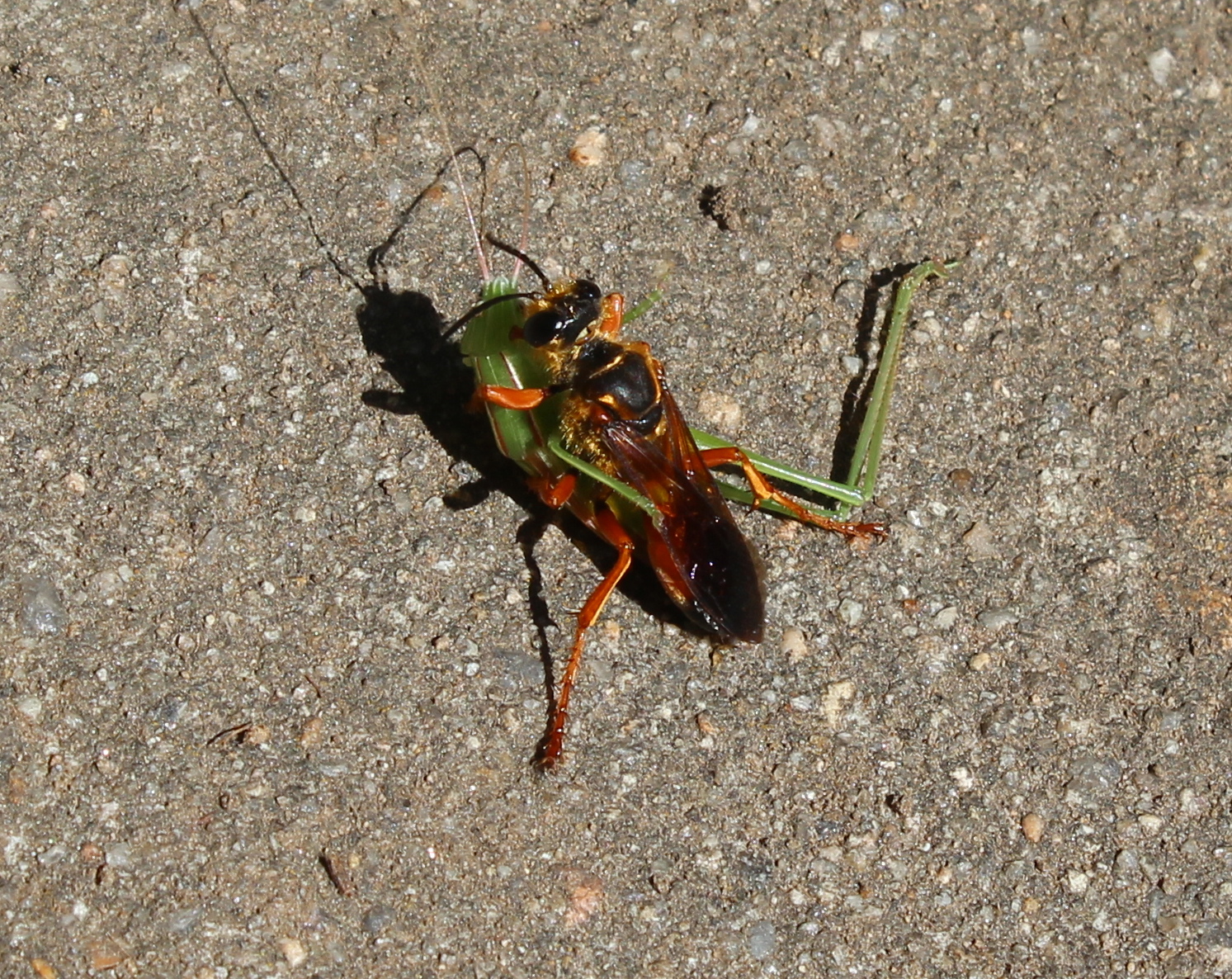
Great Golden Digger Wasp

_

Sphex ichneumoneus 

I was trying to clear back the weeds from our front walk and disturbed a Great Golden Digger wasp who was flying around with a katydid.

She probably has a lair in under the black-eyed-susans and was taking her paralyzed prey down to seal it in a chamber with an egg laid in its chest.


They are not shy and typical of solitary wasps they are not aggressive.  In fact they seem to be curious about people and pets, and often dig their burrows in high-traffic areas.


As a gardener, what's not to like?  They prey on grasshoppers and katydids, they aerate the soil with their burrowing, and they pollinate the flowers.

Thursday, August 1, 2013

Anthropology and the Religion of Progress

_

At the Archdruid Report, John Michael Greer has been taking a close look at what happens when a cultural grand narrative (or secular religion) like Progress begins to lose its grip on a people.  One of his efforts is to show his readers just how integral and foundational this kind of myth is - and how it structures the way we think - even the ways we try to reject, critique, transcend or even just understand the myth itself.

In the 1980’s and 1990’s cultural anthropology went through a kind of dry run for some of what he talks about.  There was a deep and disciplined search for a way to take the science of anthropology out of the Progress trap.  Ultimately, it didn’t succeed, so I’m curious what his take on it is going to be.

Cultural anthropology, specializing as it did in peoples who existed outside the great Western, globalizing myths, was well-positioned to notice the cultural context that contained and constrained our science and our intellectual and philosophical traditions (including cultural anthropology, of course).  Anthropologists noticed two important things, from within a strong habit of self-critique.  The first was the “handmaiden to colonialism” critique, which pointed out that whatever projects anthropologists might have thought they were pursuing, they were first and foremost participants in and collaborators with a globalizing system of extraction and erasure – that would come to control and subsume the cultures being studied.  

The second critique, which crested in the 1990’s I believe, involved the collapse of an intellectual tradition that had contrasted a kind of modern positivism (e.g. anthropologists who could count and point at data) versus a more holistic, romantic rejection of Enlightenment self-congratulation and arrogance.  However, what happened was that this “post-modern” critique, which had come to portray positivism and science as irredeemably blindered by culture and grand narratives, realized that its own critique was also irredeemably blindered by culture and grand narratives.  In one sense it wanted to claim the mantle of intellectual progress as a more honest and clear vision of the world-as-it-was, but was defeated by its own self-examination.

The problem was that we process information (including about the communities and individuals that formed the subjects of cultural anthropology) through narrativization and other forms of cognitive and linguistic sausage-making.  Replacing the modernist narrative (which is what we called the unapologetic embrace of Progress) with a critical narrative served certain useful rhetorical and even occasionally political purposes, but it couldn’t be said to be intellectually honest at its core.  That is, if the goal of science and anthropology was to see the world as it really was – and not how our preferences and prejudices would have it be – how could we possibly claim to have objective knowledge now that we’d shown our methodological tools of participant observation and narrative description to be devices that altered and obscured the world even as we perceived it.  At some point it is just turtles all the way down.

There were several work-arounds to this dilemma.  Probably the most common was to reluctantly set aside such philosophical purities and go out and do the work of anthropology secure in the knowledge that – however flawed and imperfect were the foundations of our science – at least it was better than the various forms of silliness that the political scientists, sociologists and economists were wallowing in.  (To the extent I practiced anthropology, that is where I did it.) This is current business-as-usual cultural anthropology, and it does some pretty good work in my opinion.  Others have tried to grapple with it in other ways.  There is interpretivist anthropology, which acknowledges that cultures, like a piece of literature, can be interpreted, but not explained or understood in some final, definitive way.  There is an effort to create a kind of empty vessel anthropology in which a culture can express itself while being processed as little as possible by an alien anthropologist.  There’s a retreat to positivism, which says that science should focus on those things it can measure or manipulate and leave the rest aside.

The other reaction was a move to "applied anthropology" - which makes use of anthropological knowledge to tackle real-world problems.  There is less room for pristine truth-seeking and more scope for deploying stuff that works - or at least has effects - whether we understand them or not. (Here, too, I count myself as a practitioner.) And here is where I think anthropology and green wizardry (as Greer calls it) intersect.  We are going to transition to a sustainable society - perhaps voluntarily, but more likely because we crash into some non-negotiable limits - and it's hard to see that happening without major revisions to our current religion of Progress.  

Those anthropologists who still study the exotic, study peoples on the margins – who are partially enmeshed in and partially estranged from global culture.  And I think that as Progress begins to fail – as we all become partially estranged from, but remain partially enmeshed in our culture and its great secular religion – that the things that anthropology has learned can contribute to a useful branch of green wizardry.  In my own work I’ve tried to look at the way in which anthropology has already contributed to people trying to change their own psychologies in order to create an ability to live alternatives to “mainstream culture” – as a way of escaping the seemingly inescapable.
_

Tuesday, July 30, 2013

Hummingbird moths in the bergamot

_

My favorite thing about the wild bergamot


is the way it brings in the hummingbird moths.


These moths even mimic the little birds' brashness.

wild bergamot, ox-eye sunflower, phlox and goldenrod
_

Monday, July 29, 2013

Metz Family Reunion

(click on photos to enlarge)

In the 1700's the Browns and Metz's were part of the westward colonization of Pennsylvania.

They settled at the tight end of Big Valley, farming the limestone fields on either side of Saddler's Run, where the long ridges of Jack's mountain and Stone mountain pinch together above the upper Juniata river.

The farms at that end of the valley are still mostly worked by their descendants.

My grandmother's grandfather, Samuel B. Metz was ancestor to many of these.  Most of his 15 children left descendants, and though they have obviously scattered far and wide from the valley, a couple hundred return every year on the last Saturday of July - as they have since the Reunion tradition started over 60 years ago.

They bring a covered dish, eat, fellowship, and stay for the dance.


Em Brown, the hostess
Boys gather on a fence like starlings

T. Ray checks out the grimy paw of great grandnephew, Leo

Susan keeps the tree updated
Dick Brown chats with his old babysitter, Naoma
Girls getting ready for the square dance

Cathleen, Chris, myself and Monica


Bea Brown


Porter

Volleyball happens in the hayfield


The barn dance begins


Scott and Emily Brown's barn, built in 1820, restored in 1919.

Photos by A. Brown and Kim Brown


Wednesday, July 24, 2013

Race, aggressive denialism and media timidity

_
Aggressive denialism inhibited the news media from reporting on climate change for a solid decade.  Any news story that reported sensibly on global warming was greeted by howls of outrage -- venomous comments, threats to boycott and cancel subscriptions, accusations of criminal naiveté.  If the media were willing to cover the topic at all they bent over backwards to include the perspective of irrelevant hack denialists as a "balance" to the scientific consensus.  This media malpractice persisted well past any legitimate scientific dissensus and into the time when climate change was clearly obvious in real time

The exact same tactics are being deployed to shut down conversations about race.  Any story lately, which asserts that racism is still a problem in the U.S. is greeted with these same howls of outrage.  They cry that racism would be over if it weren't for the people who complain of racism or the journalists and media outlets who report on it. The complaintants are the "real racists" - the ones trying to create racial disharmony.  Conservative pundits rage that when Obama gently claims race played a role in the Trayvon Martin murder, he is acting as the "race-baiter-in-chief."  A Washington Post columnist cries that a President complaining about racism is "disgusting", since the real problem is that Blacks are a violent,  undisciplined, irresponsible, drug-using passel of unwed mothers and absent fathers!

But the aggressive denialism toward the obvious fact of racism is being enforced much more broadly than that.  Take a look at the comments section (in this case on a story in St. Louis about grocery stores and race) and see the vehement rejection of the racism thesis - and the floodgates open with accusations of reverse racism and excuse-mongering (!) on the part of Blacks and their apologizers, and attacks upon the media that had the poor judgement to report on it.  After the story went viral, and generated huge blowback, the metro desk had to publicly justify their reasoning behind the decision to even publish such a "race baiting" article, and the editor published a full editorial making it clear that they had never meant to endorse a racial reading the of the situation.

The education of the public on climate change has had to take place against a corporate headwind and in the face of utter negligence from the cowed and timid media.  Unfortunately it also seems likely that for the foreseeable future the media will be steering clear of any effort to elucidate the obvious fact that racism is alive and well in the U.S.
_

Sunday, July 21, 2013

Attack of the margined blister beetles


_
Garden Blogging, Epicauta pestifera.


I have not been a good gardener this summer. There's no getting around it.  It's been hot, I've been distracted, and the weeds have been prolific and persistent.

(My best crops have been vetch, wood sorrel, sedge and lamb's quarter - though at least that last one is delicious.)

Still, after neglecting things for yet another week in this past heatwave I was pretty appalled to see what the blister beetles had done to the potatoes.

I have written about these beetles before.  They're regular visitors, and I'm perfectly happy to tolerate some of them, because their larvae devour grasshopper eggs.  But when they swarm, they do have to be picked off or they'll chew the leaves down to the stems and make a frassy mess of things.  And they'll move to the beets if they have to.

Here's some pretty garden tea.  Main ingredients are margined blister beetles, japanese beetles, squash bug nymphs, mexican bean beetles and their larvae.

The blister beetles contain levels of the poison cantharidin sufficient to raise blisters if you accidentally crush one - or to kill a horse if they eat infested hay.  (In low doses it was the semi-toxic irritant of the old aphrodisiac, Spanish fly - which was made from pulverized beetles of this family.)

I noticed that bugs die quickly in this tea.  I wonder if it has any potential as an insecticide or herbicide.  After it has set in the sun for awhile, I poured it out onto some sulphur cinquefoil just in case.

_

Saturday, July 20, 2013

Ants farming their treehopper nymphs


 _
Garden Blogging:

I was belatedly picking bugs out of the garden when I spied smallish black ants busy on a volunteer potato plant along the amaranth. It was hard to see what they were up to - since getting too close meant I was being bitten by smallish black ants.  I snapped some photos, and once I could zoom in I could see that these ants were farming a herd of treehoppers and their nymphs.

The hoppers and the nymphs suck on the juices of the plant, doing it some damage in the process.  The ants patrol and protect their charges in exchange for the "honeydew" they extrude.

The adult hoppers look a bit like thorns on the side of the stem, while the nymphs are bizarre little guys - white below, dark above with spines and prominent eyes that are slightly cicada like (to which they are related, apparently).

nymphs suck upon the stems
Interestingly, although my potatoes are currently being devastated by blister beetles (more on that in tomorrow's post) this plant had no sign of damage.  Presumably the aggressive ants won't tolerate the beetles destroying their leafhopper ranch.


MORE PHOTOS BELOW:

Thursday, July 18, 2013

Staying cool without A/C

_
noon, Bradford, Rhode Island 
90 F / 32 C  Air Temperature 
99 F / 37 C  Heat index 
SW 7 m.p.h. wind 

I propped an old closet door against the most sun-exposed beehive to give them a little relief from the aggressive sun - if not the stultifying air.  The cats prefer a spot of naked earth in the shade.

We live in southern Rhode Island - 6 miles from a coastline that used to serve New Yorkers and Bostonians as a refuge in the days before air conditioning.  And even today a lot of people - like us - don't have air conditioners.  This makes heat waves a logistical challenge.

Since I work at home, I maintain simple habits to keep the house comfortable.  In the winter I draw the blinds and close the curtains at nightfall to hold in the heat - and open them in the morning to catch the sun's warmth.  In the summer, I do the opposite - pulling down the blinds against the morning sun on the east and south facing windows, and the west and north facing windows by afternoon.  If there's not much natural breeze, by mid afternoon I'll turn on a couple of fans in the upstairs - one blowing inward from the eastern face - one blowing outward into the sunlit western face.

In weather like this - a string of 90+ / 30+ days - I also close down all the downstairs windows in the morning to keep in the past evening's cool air.  Even so, our cubic Cape Cod begins to heat up, and I'll place a fan on the basement steps to draw up the cool from below. (It's clear to me now why they built these houses traditionally over a great, granite-block cellar.  It's like having your own personal cave for refuge.)  But by 4 o'clock the upstairs is very hot, and the ground floor is becoming too hot work comfortably even with cold drink in hand.  I can either move to the basement, or I can choose to drive a few miles down the shore and get some exercise by going for a swim in the Atlantic.

By the time I come back - after 5 - and have a quick, cold shower, the temperature outside has fallen enough to throw open the windows to whatever breeze there might be.  And even in our heat waves the nighttime temperatures fall into the sixties at night - (low 70's at worst), so fans will bring in the welcome air.

And we aren't cooking any pot roasts . . . 
_

Wednesday, July 17, 2013

Bearding hives

_
In the summer's heat 

the bees emerge upon the front of the hive 

where they form a humming beard of bodies. 

The instinct cools the hive, 

and keeps the idled foragers 

(whose over-heated flowers have paused in their nectaring) 

from getting in the way of busy house bees.


Tuesday, July 16, 2013

I don't understand racism

_
I don't understand racism.  I don't mean that I don't understand xenophobia or scapegoating or anti-immigrant feelings or other kinds of tribalism that are part of our standard human toolkit for fucking up social relationships.  I mean I don't understand why people of African descent get treated so badly, and why that bad treatment is so relentless and durable.

The Trayvon Martin trial is just the latest confirmation - showing as it did that a man can fear, stalk, confront and shoot to death an unarmed Black teenager who's minding his own business - without breaking any laws in the state of Florida.  To the shooter's jurors, it all seemed perfectly understandable and legitimate.

I don't understand the fever dream of contempt, fear, loathing and oppression that has burned unbroken for 400 years in the body of this country.   I don't understand the parade of delusions that we invent and reinvent to call down as much slander and ruin as we dare on these people: God's righteous wrath, evolution's slow lane, a species' atavism, a dysfunctional culture of poverty, crime and dependence, or history's damaged goods.

The Chinese, Indians, Jews, Irish, Poles, and next the Hispanics all make their way out, but never the Blacks.  We'll lionize a few - though mostly those who's success confirm the race's stereotyped failures - makin' that over-sexed music, sweatin' and shootin' those hoops, scarin' those white folks.

I don't understand why so many people build their hate filled politics upon the same timeworn caricatures generation after generation.  I don't understand why we have arrayed a vast, expensive, wasteful criminal justice (sic) system whose most durable feature is the destruction of Black people's lives.  I don't understand why we do everything in our power to make sure these people don't contribute their full potential to this society.

For what?  Why this stupid, violent, pointless waste generation after generation, century after century?
_

Sunday, July 14, 2013

Crème de cassis

_
It's a good year for our blackcurrant bush.

The catbirds are too busy despoiling the raspberries.

These currants can macerate in some Stoli for a month,

before I have to decide whether they become 

blackcurrant liqueur 

or 

crème de cassis.


UPDATE: July 21.

I picked a last cup of currants off the bush and am making an attempt at blackcurrant jam.  I boiled the currants (a bit over 1 cup) with 1/3 cup of water for 10 minutes, then added a tablespoon of lemon juice and 2/3 cups of honey from the backyard and boiled harder for another 14 minutes.  Then I poured and sealed it into a clean, jelly-sized mason jar.  We'll see.

The smell of it has been bringing bees in to investigate.
_

Saturday, July 13, 2013

Friday, July 12, 2013

An Evolutionary Parable and the Age of Limits

_
Here's an evolutionary parable: 

Salamanders live in a little kettle-pond.  Clearly the sensible thing to do is to stay there and eat and mate and thrive in the relative safety of the pond.  And so they do.  But a few salamanders are clearly not sensible.  They wander off from the pond.  It turns out that it would have been much, much safer to stay in the pond and almost all of them die upon the arid, predator-infested deserts.  But a few, with little but absurd luck to distinguish them, make it to other kettle ponds and their descendants settle there and eat and mate and thrive.  And a few restless ones wander off almost always to die.  But THEY are the reason there are salamanders - a hundred thousand and a million years after that first pond and all its inhabitants have reverted to dust.


weeds consume a chair
For a human and the culture they are delivered into, it is normal to accept the waters you are given, since they are to some degree safe and tested.  The malcontent, the maladjusted and the marginalized seem to offer little but cautionary tales.

We are not salamanders and our civilization is not a pond, but there's a relevance to my little parable if I could only pin it down.  John Michael Greer, writing at the Archdruid Report argues that people are locked into our civilization's central religious cosmology of Progress (with its dualistic alter ego, Apocalypse), and they don't give it up easily or at all.  If we have run up against an Age of Limits - and I think we have - then this cosmology has become dysfunctional and delusional.  And that is one reason why humans are not doing anything significant about the problems that threaten our civilization - climate change, our total reliance on over-exploited, non-renewable resources, our unsustainable and fragile food system,  and the accelerating destruction of the generative foundations of our biological existence like soil, air, water and ecosystems.  

The problem is not that we lack solutions for living upon the earth.  The problem is that most of these solutions are incompatible with our cosmology of Progress.  Let me reiterate that.  We have solutions, but because these solutions are - for lack of a better word - heretical -  they cannot be enacted (or for the most part, even discussed).  The idea that we should be intentionally applying our considerable creative and technical energies toward building a future that is slower, poorer, and less shiny than today's is so unthinkable that people mostly refuse to think it.


a volunteer sunflower
For example, we can easily avoid climate change calamity if we are willing to leave $4 trillion dollars worth of fossil fuel in the ground, bankrupting some of the largest, most powerful economic interests on earth, and bringing the engines of economic growth to a shuddering halt.  We could move past non-renewable resources if we took only what systems can regenerate and forewent the rest.  We can feed all our people if we reigned in population, discarded the worst of modern agribusiness and transitioned to a less wasteful, more labor-intensive steady-state food system.   We could put an end to our continuous economic crises if we abandoned the fiction of global economic growth and created an economy that could smoothly function with contraction.  After all, such changes are going to be imposed on us eventually whether we like it or not.

But we aren't taking up these kinds of solutions, and that is what makes us akin to those salamanders who stay in the pond even though ponds don't last forever.  It's the obvious and sensible thing to do, right up to the moment you are baked into the shattering clay.  


rusty wheelbarrow, made in USA
So what about those wandering, death-finding or death-defying salamanders?  the ones that leave the homely waters to populate new ponds and secure the long-term survival of the species?  do they have an analog here?  I'm not sure.  The mechanics of cultural evolution and biological evolution are very different.  I only know that we need more people wandering out of this Progress-puddle we are stuck within.  Greer makes a good case that the "long descent" will happen step-wise and take generations.  In my many interviews with people (far, far from the levers of power) I've seen more and more regular people questioning the cosmology of Progress, so maybe we will be able to take off the blinders and apply our energies toward crafting a good way of living in the Age of Limits.

We'll see.
_

Wednesday, July 10, 2013

Independence Week


On Monday, we packed the boys into the car and did the long drive to Pennsylvania to deliver them to their grandparents for the month of July.  I had to sing to myself, because the radio isn't working because of some anti-theft device that was triggered when we got the car repaired.  Apparently the codes to restart a radio on a 1996 Honda Accord are beyond the capabilities of most digital archaeologists.  But we eventually cobbled together a system with Nico's old iPod.

When we arrived at my parents, stiff from the five and a half hour ride, Dad had made us spaghetti.  The sauce is a far cry from the de-jarred red sauces of our childhoods - full of elaborate flavors and chunks of vegetables.  He manages the kitchen despite being wheelchair-bound from a car accident over a year ago.  Finally, this spring, that injury cost him his leg below the knee, but he's taking the loss more or less philosophically and looking forward to a proper prosthetic.  My sister Chris was there up from Baltimore, where she's been settling into a new occupational therapy job after spending much of the past year tooling around the country camping, going to ashrams, and being voluntarily unemployed.  And my cousin Fred was there as well -- staying at the house for a few months until the Sesame Street Live tour picks up again in September and he goes back to his life as a dancer.  We ate out on the back deck under the oak trees that aren't dropping acorns on us this time of year.

My parents live in a low, long, log cabin - the fireplace end of it built out of large fieldstones.  Years ago, soon after they'd bought the 6-acre property they'd put in a two-car garage with an office and an upstairs apartment.  (They call it GASP, which is an acronym for something I can't remember, but is also the sound they made when they finally realized what it was costing them to build.)  But it is where the bodies go when the extended family descends.

photo: Chris Sholly, Lebanon Daily News
On Tuesday morning, Mom, who's active in the county Democratic Party, was going out to support her candidate for Governor of Pennsylvania - a local county commissioner making an (apparently quixotic) run for statewide office.  I tagged along both to spend some time with my mother, but also because she wants to contribute to the campaign by hiring me to do some consulting - and I'm looking to get involved in more direct advocacy.  So I met the candidate and we were both pressed into service as props behind her as she made her announcement upon the steps of the state capital building.  Anyone watching the evening news in Central Pennsylvania that evening saw me standing attentively at her shoulder as she gave her speech to the cameras.

In the evening we all went to see The Lone Ranger at the Allen Theater - a local movie house  in the old style.  The coffee shop half of it bustles and will sell you decent popcorn and soda or expresso.  A vigorous young organist tickles away at the little Wurlitzer like a living calliope while people find their seats.  The owner makes few welcoming announcements, the red velvet curtain opens and the movie shows.  The film itself, by the way, is a chaotic mess with enough going on to mystify and entertain and annoy everyone.  But we were in the mood to be entertained. (excellent review here)

On Wednesday, the others went off to Kutztown, where my sister Cathleen lives, to go to the fair.  I stayed home with Dad to do repair some footpaths.  There's a path down the hillside to a little creek, and a wooden footbridge that crosses it to the boundary of the State Game Lands.  From there  we can walk along the stream and up out of the ravine where the old Lebanon-Cornwall railroad bed has been converted to a rails to trails pathway.  But our own path was overgrown, so I took loppers and an ax to trim the encroaching spice bushes and hickory saplings and to remove a few logs that had fallen across the way.  As the footbridge replaces one that washed away a couple of years ago, it isn't in exactly the same spot, which means someone has to pull up ten feet of ancient, half-buried, rotted steel fencing that was now in the way.  And since my  Dad is one-legged for now, that meant me.  It was pleasant, sweaty, dirty work.

photo: Fred Mursch
I washed up and drove to Lancaster to see old friends to drink imported German beer and have elaborate Mexican-style salsas - which had been my excuse for not going to the Folk Festival all along.

Thursday was the Fourth of July, and with the arrival of the Kutztown contingent we made up an even dozen.  It was a classic, hot, summer day spent mostly in and around the pool.  The water was beautifully cold from the hose that was running into it to make up for a slow leak caused by an ill-advised pole-vaulting effort from a few year's back - (the repair now needs a repair).

My father has become an activist for planting native meadows, and the property around the pool is a-blossom with flowers --  milkweeds, bee balm, queen of the prairie, ox-eye sunflowers, pasture thistle, joe pye weed and more.  Swallowtails and fritillaries flit, and the bluebirds were fussing around their nest-box, complaining loudly.  A small black racer sitting comfortably in the box - head and tail-tip sticking out.  We thought the birds might have laid their eggs already, (the first brood have already fledged), but when the snake slipped back out among the flower stalks it showed no tell-tale bulges.

My home-town was holding its 196th consecutive Independence Day celebration in Lititz Springs Park (though it's true that the 1863 version - with the cannons of nearby Gettysburg almost audible - was a muted affair).  A powerful spring wells up in a round pool and rushes out a stone lined channel to a fountain at the other end of the park.  On the Fourth the stream is roofed by wooden frameworks and trestles, covered with thousands of white candles.  After a senior from the high school is ceremoniously crowned the "Queen of Candles" she lights a torch that passes to boy scouts and other kids who scamper around lighting wicks.  I watched them wade into the frigid pool to ignite floating platforms in the shape of swans.

Photo: Fred Mursch
Later this old-school pyrotechnics gives way to the modern - one of the best fireworks displays you'll find in the US.  Synchronized to music, the show blasts away over the thousands of people crowded onto their blankets on the ball field below.  Leo - nearly three years old now - sat in my lap awed by the display.  But awe for three-year olds is fleeting and soon he was jumping up and down on Fred and head-butting Nico.  And Bridget, who's nearly 5 fell asleep through the deafening grand finale, and had to be gathered up and carried for the long, shuffling departure.

On Friday, Monica, Cathie, Eric and I went to a riverside festival in Harrisburg to see an old friend of mine playing in his band.  He and I used to be best friends and play chess in Kindergarten but by high school he was reading chess books and I couldn't manage more than a win out of three.  He's in a band with another old friend, Trixie, who's a music teacher, and they play their excellent and eclectic music once in a while, where people gather who expect more from a band.  The crowd in the breezy park was small, but it grew as the hour-long set went along.  After the show, the musicians had to leave, since music doesn't pay the bills and the van-owner had to go to work.  So the four of us went to a late lunch - or would have if we hadn't come first to the brewpub with 120 varieties of craft beer.  Much later they went in search of a Peruvian restaurant, while I went off famished to get reacquainted with a friend who'd disappeared off to Indiana thirty years ago.  And I ate stromboli and we talked long of kids and careers, divorces, migrations and the changing of plans.

Saturday morning I helped Dad load up a dump truck that he'd finagled a roofer-friend into leaving for the weekend.  A decade's worth of junk accumulation - at least all of it that couldn't be recycled - went up into it for the trip to the dump.  But by 11:30 I'd discarded my filthy clothes, swum, showered, and cooled down for our long drive back to Rhode Island.

It was a deeply satisfying visit - a week leavened and enlivened by the important things in life.
_


Tuesday, July 2, 2013