 |
| hot dogs at the campfire |
Saturday, October 13, 2012


Tuesday, October 9, 2012

Monday, October 8, 2012

Rather than spending a day celebrating or denigrating this particular 15th century adventurer, I could wish for a "Colonialism Day" - akin to Yom Kippur, the Jewish day of reflection and atonement. It should be a day to think on the human genius for exploration, discovery, exploitation and genocide.
There are many things I value about our civilization and the civilizations we are sprung from -- but for all the glories draped upon their shoulders, each stands knee deep in blood and human suffering. Pretending otherwise seems a dangerous and damaging delusion.
This should be a day to reflect from our imperial heights - even as we each push in our own ways to make the world a better place - even as our nation's bombs fall in Asia - even as our policies ensure that the goods that flow towards us are wrung from the labor of the world's poor and vulnerable.
If we build our own standard of living on suffering and the stunting of others' lives, we should at the very least know that fact.
Even if on that day the stale pleasures of consumerism turn to ashes in our mouths.
_
Sunday, October 7, 2012

_
If a colony of bees loses its queen, the workers will create a handful of new queens from the last eggs the former queen has lain. They feed a few of these royal jelly and expand out their wax cells to accommodate the overlarge females. Once a new queen has emerged (and dealt with the other claimants), she departs alone and takes her nuptial flight. There are places that drones from many colonies gather (since they do no work for their colonies) and the queen flies to one of these to mate with these foreign males. She may fly agains someday if the colony prospers and she departs with a swarm to found a new hive, (leaving a new queen behind to supercede her) but she won't mate again.
Sometimes though, a queen will fail without leaving behind any fertilized eggs, and so the workers can raise no new queen. In this case workers will often begin laying eggs. But because the worker bees are not fertilized these eggs cannot be nurtured into a new queen. In fact, its a quirk of bee genetics that unfertilized eggs become the male drones. So at first glance the behavior seems pointless in the doomed hive. Once the last generation of worker bees die there will be no more colony.
But there is a evolutionary sense to it I suspect. This failed colony will mother no new queen -- no new swarms to carry forth the genetic heritage. But there are two ways to reproduce, of course, you can mother a new colony or you can father one. What these worker bees are doing in their last gasp effort is cloning themselves into males who might be that father, who might win the lottery and find that queen out there on her nuptial flight and be the father to a hundred thousand busy descendants.
 |
| A drone on the hive's landing board. |
_
Thursday, October 4, 2012
_
A flock of titmice came to the bird feeder and with them was a red-breasted nuthatch. The pretty little nuthatch wasn't interested in the seeds, so it preened itself while the others squabbled over feeder dowels and chattered with the chickadees.
A phoebe perched upon a naked maple branch, flicking its tail. I thought she'd have left, trailing behind the swallows. But the insects are still flying, and maybe she's had a premonition that winter is not coming.
_
_
The first Presidential debate seemed destined to take the wind out of progressives' sails. The Obama that showed up was the centrist, bureaucratic Obama - the one who often seems content to take Republican policies and re-shape them to do the least harm. The Obama who seems reluctant to call out the current Republican project for the cynical deception that it is.
I'll vote for Obama, because although I don't think Obama's centrist complacency is up to the task of solving many of our problems, Romney's backers, given the chance, will turn us all into serfs.
UPDATE: I'm not going to spend much time reading the debate post-mortems, but I think Grist's David Roberts gets it about right.
UPDATE: I'm not going to spend much time reading the debate post-mortems, but I think Grist's David Roberts gets it about right.
_
Monday, October 1, 2012
_

When you keep bees you begin to pay a different kind of attention to the seasonal parade of flowering plants.
In October, there is still the stray blossom of brown-eyed-susan or hawkweed, but these days belong to the fading goldenrod and the burgeoning asters.


And suddenly, behind the beehives, the tall shrubby weeds (which I'd planned to pull out) have blossomed into a thicket of frost aster that is buzzing and rustling with foraging bees.
I have left a few frames in the honey supers on the hives (separated from the brood chambers by the inner cover) hoping that the bees will clean the comb and take below whatever nectar and capped honey remains. I'll look in when we get one of our promised warm days, but I suspect they're still laying more nectar in.
There are a half-dozen species of aster and at least three species of golden rod around the property. Wasps and bees are busy at every stand.
There are a half-dozen species of aster and at least three species of golden rod around the property. Wasps and bees are busy at every stand.
 |
| Photos A. Brown |
Sunday, September 30, 2012
_
I've often compared humankind's collective intelligence to that of a plague of toxic lichen -- mindless, yet effectively destructive. Brian Kaller's girl takes a more constructive view:
As we talked we decided that the rivers were the blood, the rocks were the bones, soil the flesh, and animals were the nerves.“What kind of germs are we?”It depends what kind of person you are, I said. Some people have been like the bad germs, making the world sicker.“Can we be like the white blood cells?” she asked, knowing that they patrol the body and heal it.
I have to think Gaia's immune system would welcome such allies.. . . “I’d like to be a white blood cell when I grow up,” she said.
_
Thursday, September 27, 2012
_
I'm a scientist by profession. I make hypotheses and we prove or disprove them as best we can with experiments and with other forms of empirical testing. The essential action is to give reality a fair shot at proving you wrong. And to accept being proven wrong, with grace and curiosity and without denial and defensiveness. It's one of humankind's ancient and great inventions. But it is one that sometimes goes into eclipse. Because we have an equally ancient and great invention, which is to create our own fantasy worlds that resist any disprovement that reality can throw at them.
Generally our empiricism and our delusions coexist in a typically human muddle. Sometimes they inflate all out of proportion and collide with public violence -- as when Galileo and other observers challenged the delusions of the Catholic Church, or when the fantasies of the Soviet state became too embarrassingly unreal even for Russians.
I suspect that we're approaching such a collision in the US. Over the course of the last 40 years trust in science has plummeted in our society -- but only for that third of the population that identifies itself as conservative. Much of this would be familiar to Galileo, not so much for the religious contrariness (though that is there, of course), but because of the way that temporal powers choose to perpetuate the convenient fantasies that support them, even if it means denying the realities that science is exposing and the authority it is building, and even if it means walling oneself off from reality-testing in self-defeating ways. In 17th century Europe the antagonist was the Church hierarchy, in 20th century America, this was a business class hostile to the growing power of science to regulate private enterprise and influence policy formation.
In the 1970's, trust in science wasn't particularly politicized. But 40 years of hostility from conservative leaders and an increasingly vast and sophisticated media empire has changed that. There are multiple avenues for this: political attacks on science-based institutions like the EPA; the effort to bring scientific research back under the control of private enterprise by de-funding universities and other forms of publicly supported science in favor of privatized, industry-funded research (and then hindering scientific exchange with patents and gag restrictions); support for pseudoscience like "creation science" and the concoction of conspiracy theories like "climategate" and "liberal media bias" in order to undermine any reality-based consensus.
But mass willful delusion in the service of the status quo is something that this country won't be able to afford for long. 3 problems are converging on us at the same time -- global climate instability; the declining accessibility of cheap oil; and the fragility of our unsustainable food systems. These challenges might be addressed, even solved, but without science and a clear-headed, reality-based understanding of things, we are looking like nothing more than the apocryphal lemmings scampering toward the cliff.
But mass willful delusion in the service of the status quo is something that this country won't be able to afford for long. 3 problems are converging on us at the same time -- global climate instability; the declining accessibility of cheap oil; and the fragility of our unsustainable food systems. These challenges might be addressed, even solved, but without science and a clear-headed, reality-based understanding of things, we are looking like nothing more than the apocryphal lemmings scampering toward the cliff.
_
Monday, September 24, 2012
_
My sisters and I descended on my Mom to celebrate her 70th birthday. She had long since convinced us not to throw a big party like we did for Dad's 70th. So we left the grandkids looking after each other and went out to John J. Jeffries, a Lancaster PA restaurant where they turn sustainably raised, locally sourced seasonal foods into phenomenal cuisine. We shared around the food - among the seven of us we managed to cover a good portion of the menu - and the wine and champagne flowed.
We each toasted her, and she was a good sport, though she's always avoided being the center of attention whenever she could. I suspect that if my Dad hadn't bragged about it that she never would have mentioned that she was being honored with the 2012 Jefferson Award for Lebanon County. Each county in the area singles out a volunteer to be recognized for their public service. Mom has kept the county's VITA program going for years now. It's a volunteer service that organizes free tax preparation for low income people, to make sure they take full advantage of their deductions, the EIC and so on. She's a little perplexed as to why she was selected for the award, since she thinks it should go to one of the super-volunteers who devote more hours than she does. Running VITA may be less glamorous than some volunteerism, but this year her work helped keep nearly a million dollars in the community that otherwise would have gone away. And it put that money right where it can do the most good -- into working people's pockets -- to be spent locally and ripple out through a community that will take all the stimulus it can get. So I'm thrilled that both she and that program are getting some well-deserved recognition.
When we'd eaten all we could, we headed back along the windy country roads to home, where the kids hadn't burned the house down, but were settled quietly in front of their various screens . . . .
When we'd eaten all we could, we headed back along the windy country roads to home, where the kids hadn't burned the house down, but were settled quietly in front of their various screens . . . .
_
Wednesday, September 19, 2012
_
I went to church today for the first time in too long a while. My church is never indoors. Today it was a beach with waves breaking upon it. Clouds overhead shimmered in the sinking sunlight - herringbone, mare's tails, ragged contrails smudged by smoke from distant fires. Porter, Nico, Jose and Anna Carla played with a football in the avenue of sand between the dune grasses and the crashing water. Thousands of monarch butterflies fluttered in the wind, hewing to this coastline of goldenrod and dune rose on their impossible migration toward Mexico.
I was immersed in patterns. The ripples colliding in pools spilt into by the waves; the sloshing of the eternal ocean; the sinking sun; the summoning of the butterflies southwards.
There was a channel in the sand where water returned to the surf, and I digged in that - sculpting the ripples and currents into new forms - however brief and ephemeral they might be - until another churning wave erased my interferences.
_
Wednesday, September 12, 2012

Monday, September 10, 2012
_
 Saturday evening, I looked at Youtube videos -- disregarding the elderly beekeepers, gloveless and in shirtsleeves with their placid hives, and gravitated toward the suited-up folks youngsters diligently jetting smoke between each frame; re-learned the technique of striking the full frames hard on a stone to dislodge the bees onto the ground (rather than using the bee brush to turn them into an airborne cloud of stingy anger). I learned the importance of having a container at hand to stash the frames, so the bees aren't swarming around the combs to steal back the honey. I talked to an old beekeeper and learned that bees do indeed get irascible before a storm. In short, I did what I should have done Saturday morning.
 I suited up with boots and winter gaiters and flannel-lined pants, two shirts, a veil and gloves. I practiced with the smoker until I could keep it going. I took out the old Coleman ice chest we keep "forgetting" to give back to my parents. And then, diligently jetting smoke between every hive body and every frame, I took out 17 frames of capped honey to go along with the four I'd taken yesterday. There was more in the boxes, but not all fully capped with wax, and I didn't want to strip the colonies bare and have to feed them sugar. Most importantly, there were no stings and not a barb to be found upon my armor.

I sent Jake home with a couple of pints of honey, for his help,
and I think I know what I'm giving people for Christmas this year. . .
Saturday, September 8, 2012
_
The bees seem to have been filling up the honey supers, so I've borrowed a honey extractor -- a kind of centrifuge -- and made my first attempt to steal honey. It was utter fiasco. I started with the most cantankerous hive, couldn't get the smoker to work, but pushed on foolishly nevertheless. On tope of it all a storm was moving in, so the bees were extra irritable.
By the end of the process - after armoring up three times - I was in winter boots, gaiters, and flannel lined pants -- and covered in pissed off bees. In exchange for 9 stings I got four frames of honey.
Only two more hives to go.
In lieu of angry bees, here's a picture of Haru.
 |
| Click to embiggen |
_
Thursday, September 6, 2012

Wednesday, September 5, 2012
_
And so the summer got away from me . . . in July we burrowed back into our homelives after the 3 weeks in Colombia -- Monica working the Nature Center camps -- catching frogs and snakes and vying with the kids in games like predator or sharks and minnows -- bruised and scuffed and turning browner despite her best efforts with the sun screen. Me at the computer doing my bit to reform the US public policy discourse -- on social security, jobs quality, unionization. Dabbling in the garden as growth stalled in the rainless heat. Adding a honey super to the hives and letting the bees do their thing with whatever flowers they could find. At the end of July was the family reunion in Pennsylvania, where 200 members of the scattered clans gather at the farms in the home valley and eat and gossip and dance at my cousin's barn. And there we handed the boys off to the grandparents for a few weeks. I tore out the rotten bathroom wall and slowly learned the art of tiling. Prepared for the return of our boys and got the guest room ready for a third, temporary son joining us from Mexico for the year. Monica painted over the wallpaper -- fuschia flowers never to be seen again.And I didn't blog as weeks and weeks piled up and fell back down, and the world didn't seem to move any closer to solving problems: careening climate, the exhaustion of representative democracy and senescence of civil society, encroaching energy decline and economic contraction, the increasing brittleness of the food system . . .
But it is time for school to start, and José is here. Homework and shooting hoops and lunches to be packed. Kimchi is nearly ready, beets are pickling (except those that Monica turned into borscht), and while some tomatoes are finishing a few are just getting started. And there is much data to be crunched at work, which is at least a solvable challenge. Nine tenths of the potatoes haven't been dug and firewood needs to be cut and stacked.
So it is time to re-boot this blog. As long as I can remember, I have kept journals as a way of leaving a trail of bread crumbs behind me in the continuum of time. Without fixed points of text and language, life takes on too much of a hue of unreality, as though we could edit the past as haphazardly as we re-write the present and the future. And in a society that seems to have unreality braided into every fiber, I don't think I can afford to lose what tenuous track I have.
_
Saturday, July 14, 2012
The Colombia Journey
a wrap up

We spent nearly 3 weeks in Colombia, and rather than try to see the whole country, we chose to base ourselves in Antioquia and specifically in Medellin - to get to know that city and the towns and valleys around it. Though I still like the road-trip style of travel, where you keep the scenery rolling by and the pace peripatetic, I like even more the staying put and digging more deeply into a place you've never been.
For Monica this was an opportunity to re-aquaint herself with a place and with people that had helped form her long ago. For the boys, this was to rattle their cages and open their eyes to a heritage that they are mostly oblivious to. For me, it was a kind of recreational anthropology, where I got a explore an unfamiliar culture from all the many angles and vistas that Monica's relatives generously made possible. There's an old anthropology expression that says, immersing yourself in another culture "makes the strange, familiar, and the familiar, strange." In that way, you not only see the sense in a new culture, but get to see your own culture through new eyes. In the process your brain gets stirred all the way down to the reptile parts, which is subtly disorienting and awake-making. And that's a good thing.
So, for all that the trip was a great success.
I have posted pictures and accounts in seven installments, and if you'd like to view things as I wrote them:
 |
| The morning view from Uvital |
Friday, July 13, 2012
The Towns
 |
| Campesino, Santa Fe de Antioquia |
 |
| Central plaza, Santa Fe de Antioquia |
 |
| Sunday, Iglesia de Santa Barbara, Santa Fe de Antioquia |
 |
| Turistas |
 |
| Yellow dog in the street, Fredonia |
 |
| Black dog, Fredonia |
 |
| Philly and Fruit seller, Fredonia |
 |
| Nico in Venezia |
 |
| Hauling fodder, Venezia |
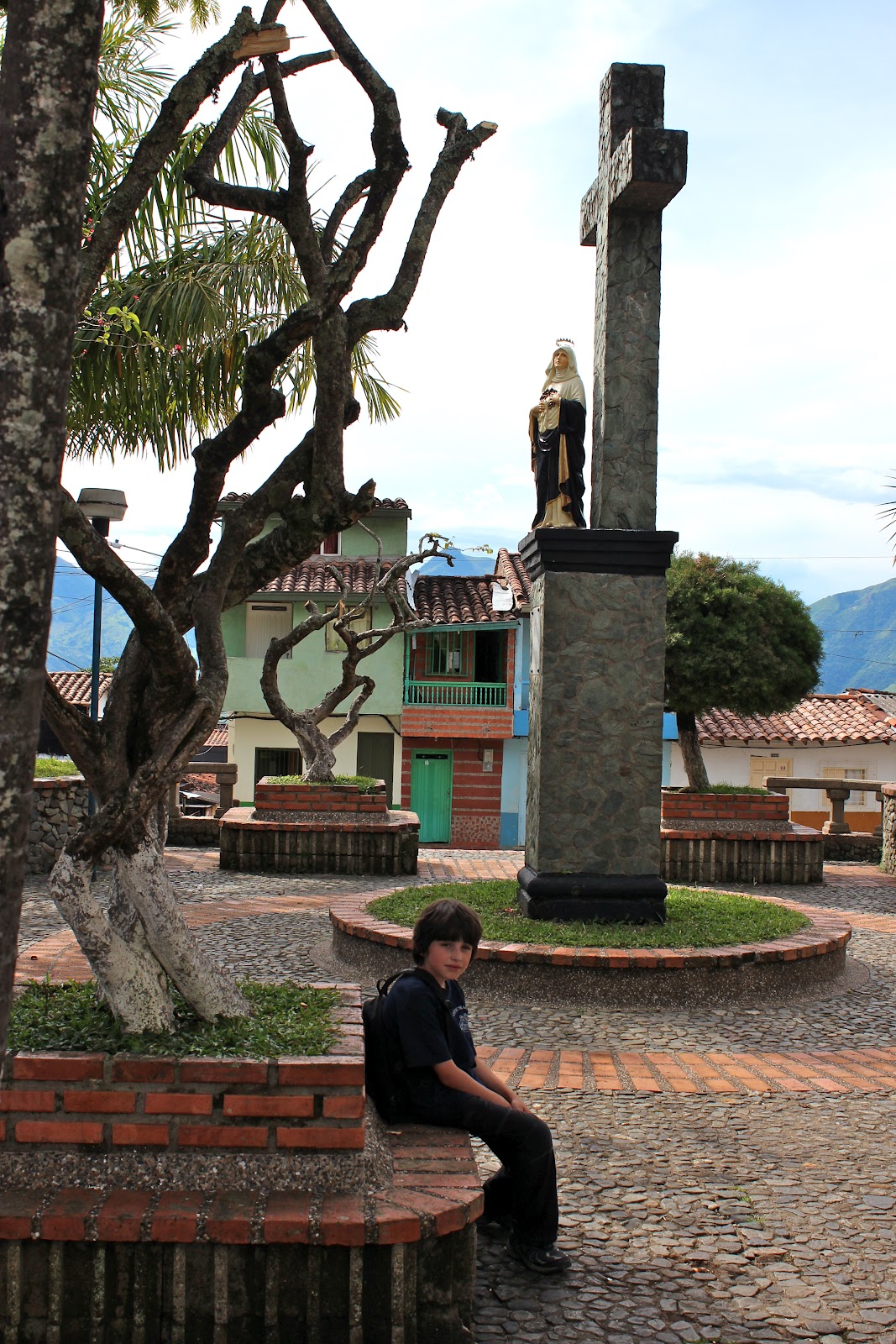 |
| Town park, Venezia |
 |
| Chivita, Guatape |
Thursday, July 12, 2012
Colombia Journey 6
Guatape and Piedra del Peñol

The rock of
Peñol is a good old-fashioned tourist trap. A hulking, sheer-sided rock over 600 feet high sits incongruously alongside a large reservoir. In a cleft in the rock, industrious entrepreneurs stitched a zig-zagging stairway from top to bottom. Even if it is not the wooden deathtrap of days of yore it is still a remarkably iffy-looking construct of brick and concrete. At its base is a clamorous encrustation of cheap cafes and tourist kiosks, peddling everything from mochillas, keychains and sunglasses to Pope John Paul II portraits and jokey dishtowels. A few boys hawked donkey rides. At the top of the rock someone had built an ugly tower of badly mortared brick. Up there were more cafe's though not as dense, and barbed wire fence to keep people from falling off. Bromeliads find purchase somehow on the rock faces, and in turn they offer a resting place for litter thrown or blown from the top. Loud, tinny music completes the scene.


Years past, a mayor of Guatapé had grown annoyed that it was called the Rock of Peñol, despite the fact that Peñol had been drowned in the reservoir. Since the rock rightly belonged to the town of Guatapé he had painters begin emblazoning the rock with the name GUATAPE´ in white letters several stories high. But national outrage brought a quick end to that project and he only got as far as the "G" and part of the "U" - and so an enormous GI, only slightly faded, adorns one vast face of the rock.


 Guillermo hates all this vulgar ruination of a unique natural site -- and I sympathize. But I admit to having a weak spot for this kind of tourism. Maybe it is nostalgia for some of the 3rd rate tourist traps of childhood (what 5-year old can fail to be impressed with a two-headed calf or a deformed pig's fetus preserved in jars of amber liquid), but also it is just seeing the families out for the day enjoying themselves; the ludicrous interactions of young couples climbing the 700 steps together to the heights; the kids skipping past; the guy jollying people into getting their pictures taken. And too, the craziness of those cockeyed flights of steps stitched into the rock with such reckless optimism.
 The nearby town of Guatapé is a pretty and full of color -- apparently GI-man was not the only relentless mayor -- because all of the houses are freshly and boldly painted. And each has a kind of stucco or tiled wainscoting bearing some set of emblems or little bass relief scenes. Some are just stylized flowers, but others are bucolic scenes or owls or chess pieces or billiard tables. Flower baskets hang from every balcony.

Little three-wheeled chivitas work as taxis. They are as intricately painted as their larger cousins, the chivas. We walked the streets and I took pictures, because the town seemed as though it would be insulted if I didn't. Porter walked the little dog, Sophie.

Subscribe to:
Posts (Atom)
