Saturday, April 24, 2010


Friday, April 23, 2010
A headline in this morning's NYT illustrates the power of words to frame an issue. The article, stimulated by the recent mining deaths in West Virginia, was entitled "2 Mines show how safety practices vary widely in US." "Safety practices" -- isn't it good that mines have these things to protect the miners? Hmmmm. But they "vary"? Well it sure sounds like a technical issue that these companies have to keep track of as they keep their workers safe.
Now imagine instead a headline like, "Some mining companies are more willing than others to gamble with workers' lives for higher profits."
It's exactly the same topic -- the reality that worker lives are put at risk for company profits; some companies are more careful than others with the lives and health of their workers; and the profit-motive often gives them an incentive to take chances with their workers' lives.
But that sure sounds like more of a problem than variance in safety practices. It almost sounds life and death.
Thursday, April 22, 2010
The Harrah’s hotel and casino sits on the river between Omaha and Council Bluffs, Iowa – so that gambling doesn’t technically take place on Midwestern soil. I wasn’t there to gamble but to give the keynote address to a gathering of a couple hundred meatpackers. In particular these were union organizers for poultry, pork and beef plants from around the country.
Normally, this kind of task would fall to Axel or Joe, but neither of them were available, so I had taken the morning flight out of Providence. Axel had warned me that I’d need to be the opposite of professorial for this crowd, so I’d left my suit jacket and black shoes at home, and cleansed the powerpoint presentation of its pretentious phrases.
Thursday, April 15, 2010
Tuesday, April 13, 2010
I took two loads of mildewing cabinetry, old drywall scraps, and decaying particle-board toward Westerly. All of it was stuff that shouldn't have been in the basement in the first place -- nothing really of value. The town has put out dumpsters at various places for storm-detritus. The section of route 91 to Lakeshore drive had been well underwater in at least four places a week ago and the area still looks like it has a bad case of bed head. Fences buckled under the push of water and debris, new potholes and eroded gullies, sand and gravel in the woods. And the water in the swamps and rivers is still seriously high -- ready to gush over the banks with any new dousing of rain.
Monday, April 12, 2010
Above the highway are two birds -- sparrows or finches -- locked in deathfight. The morning sun lights through the spinning featherball, that is fluttering, sputtering downward. Too fast falling toward the destruction of traffic. But the sparrows, or the finches, are intent only on their own murders. Now my car is there. Somehow the featherball misses the center of my windshield and rolls upon the air cushion that encases us. In the mirror I see a car close behind me, but the birds drop and are swept under the front bumper. Do they rise again from their little double miracle, or are their battle and their bodies just obliterated by the thousand cars behind me?
Saturday, April 10, 2010
San Francisco's Market Street was sunny and full of people. Everyone was in good spirits, the pale tourists, the suits chattering into their bluetooths, the hipsters in ill-fitting clothes. I sat and drank my coffee on a stone bench that circled back around a pillar of vegetation. In a paper bag beside me I had a peanut butter cookie that I was breaking pieces off. A crazy woman, blonde and raggedy and mute sat down beside me and I picked up the cookie. She gave me a look of theatrical affront -- as though I had accused her of trying to steal my cookie. She stood up, shook her matted hair out from her bandana and slowly circled the bench looking around but always returning to me with her look of affront. I ignored her mostly. Finally, she stopped few feet away and poured a splash of coffee onto the sidewalk. She giggled and skipped away as a dozen ratty pigeons arrived. They gathered in front of me, walking even under my legs, tilted heads staring upward with their little reptile eyes and leaving dime-sized dollops of pigeon shit beside my feet. I put the remainder of my cookie back on the bench. The woman left, but the pigeons didn't.
Friday, April 9, 2010
I flew out to San Francisco Saturday -- on a bit of working vacation, but also to give Madi and her partner Diana a hand with things. After years of feeling little but dislike for cities, I'm beginning to find them interesting again. Or at least ones like San Francisco that actually realize some of the potential of what cities should be.
After the downpours of Easter Sunday, the city and its air was freshly washed and scrubbed. The retro, brightly colored streetcars glowed. People walked, seagulls cruised, morale was clearly high. From high spots - Bernal Hill or Holly Park - I could see the whole city sprawled below and its bridges out into the bay. From low spots the colorful, whimsical diversity of San Francisco's hill hugging architecture entertained the eye. From cafe or bench I could watch the panoply pass. And the farmer's market at the Embarcadero would break Monica's heart.
I'd go out to find a restaurant for lunch, but both Madi and Diana are excellent cooks, so we mostly ate dinner at home together with their little girl, Lily. On Tuesday I worked for a few hours in the morning, but then took the tram to the SF MOMA.
Although most modern art leaves me feeling slightly foolish (either because I suspect I'm being duped or just clueless) there are always a few pieces that make me pause and engage. But it was the photography -- documenting the scapes of the city and the state -- that was stunning and made me question how I could be traveling without a camera.
Thursday I flew back to sodden Rhode Island and it was good to be home.
I arrived home to lilacs pushing out leaves, yellow blossoms on the currants, and two fruit trees blooming in pots and needing to be planted. But a rainy Friday re-filled the pools in the yard and doused any chance of gardening. Just as well, since I needed to get back to work for Cultural Logic.
Saturday, April 3, 2010
The Flood of 2010. When March broke the record for wettest month ever in Rhode Island history.
The ground was already soggy when it started raining on Tuesday, and by evening the smaller streams were out of their banks. By Wednesday the rivers had overflowed as well. The Blackstone River flooded and the Patuxet River cut off I-95 between here and Providence. But it was the Pawcatuck River and its tributaries down here that wreaked havoc for us. The Wood River sunk the Woodville-Alton Road and overran the route 91 bridge to Alton threatening to burst the dam there, cutting us off to the north. Downstream, below the merge with the Pawcatuck the Burdickville Crossing was under water a hundred yards wide, cutting us off from the east. And to the south, although the Bradford bridge was above water, the road was not and the river ran across and through the Bradford Dye Works. To the west and south, Chase Hill road was cut off and route 3 down toward Westerly was flooded at French Village (though people were getting around that for awhile by getting on the bridge via Old Cemetery Road). Westerly, Stonington, Pawcatuck, Hope Valley, Old Mystic and so on were all flooded -- many without electricity as substations were inundated. For a time route 216 was impassable beneath the Ashaway river and our only way out was route 3 up to 95.
Our sump pump ran non-stop for 2 days -- never draining the water down enough to switch off. I had to swap in our spare several times to keep the motors from burning out. On Wednesday, when the battle was being lost, our house was pretty much surrounded on three sides by a new pond of sluggish-flowing water. The water rose to 5 or 6 inches in the basement despite two pumps running simultaneously. If the electricity had gone out we would have quickly had several feet.
Monica was trying to get an interview for a job at Brown and actually tried to get up to Providence on Wednesday, but was stymied by the Patuxet and all the flooding in Warwick. On Thursday morning, I-95 was still blocked, but she found a route more inland and managed to get to her meeting. By Friday, the rivers were falling and some of the bridges cleared for traffic. And now, with the ground utterly soggy, people scan the weather reports hoping for a few dry weeks -- knowing that the next rainstorm is going to lay itself right down on top of all this wet.
Tuesday, March 30, 2010
On Monday I pulled the jute rug out from the basement where it had gotten wet during the last storm. (The electricity had gone out and left the sump pump without power.) I thought I could burn it rather than hauling it to the dump. There was also some pieces of wood from discarded furniture -- including, unfortunately an old TV case that the Kendalls had left behind. Jake and Porter added Silva's Christmas tree that they had salvaged from the woods where he'd discarded it.
And, well, long story short, I've now used up my one free warning from the fire department when it comes to illegal burning. Funny how quickly Porter and Jake disappeared once the firemen started showing up.
Monday, March 29, 2010
It was a good trip to Costa Rica. We got to stay with Clara and Eckart and Sofia (who's nearly 6 now!) in San Jose. And they all came down with us to the Osa Peninsula for a few days. It's not one of the most accessible parts of the country. In fact, you can only get to most of it by boat -- in our case an hour down the Sierpe river through one of the world's great mangrove forests, out to the Pacific and then a beach landing below Casa Corcovado on the borders of the national park.
We didn't stay at the hotel, but at the house of the owner, Steve, a friend of Clara and Eckart's. He's a guy from Chicago who rode a barge down in the early 1970's and stayed. Carved a living for himself literally in the jungle and now owns a beautiful lodge that he's built there. And he's proud that he's the only hotel in Costa Rica to receive the highest rating from the country's sustainable tourism program. To us he was a generous host, not just sharing his house on the beach, but feeding us at the restaurant, leading us on a hike to the Pedrillo River in Corcovado National Park, taking us snorkeling on the coral reef at Isla Caño, and helping the boys with their sand castle engineering efforts.
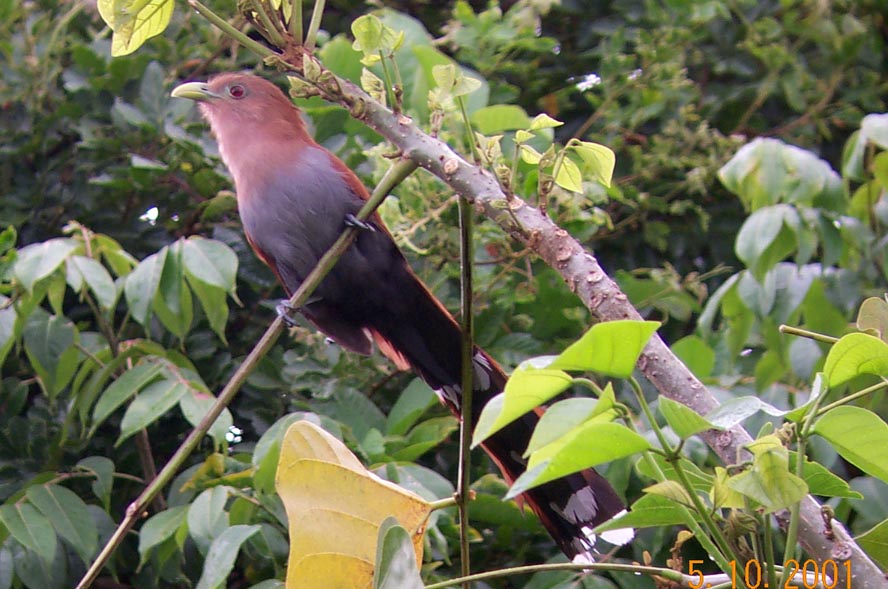
Scarlet macaws dropped beach almonds on the boys heads as they played, the mangrove hawks keened, capuchins and spider monkeys disputed over a fruit-bearing tree, while we sipped our beers. Toucans, trogons, honeycreepers and cuckoos were in the trees. Magnificent frigate birds and brown pelicans cruised the coastal air currents and a million hermit crabs streaked the sand. Coatis snuffled along the verges. Long-billed Hermit hummingbirds sipped from the long native blossoms, but the little banaquits nipped the flowers' base to steal the nectar. Jungle plants, down in the gloom with us fought for their drops of sunlight and army ants scouted among them. Porter spied agouti foraging silently and we all swam in the waterfalls of the San Pedrillo despite the false coral snake in the rocks.
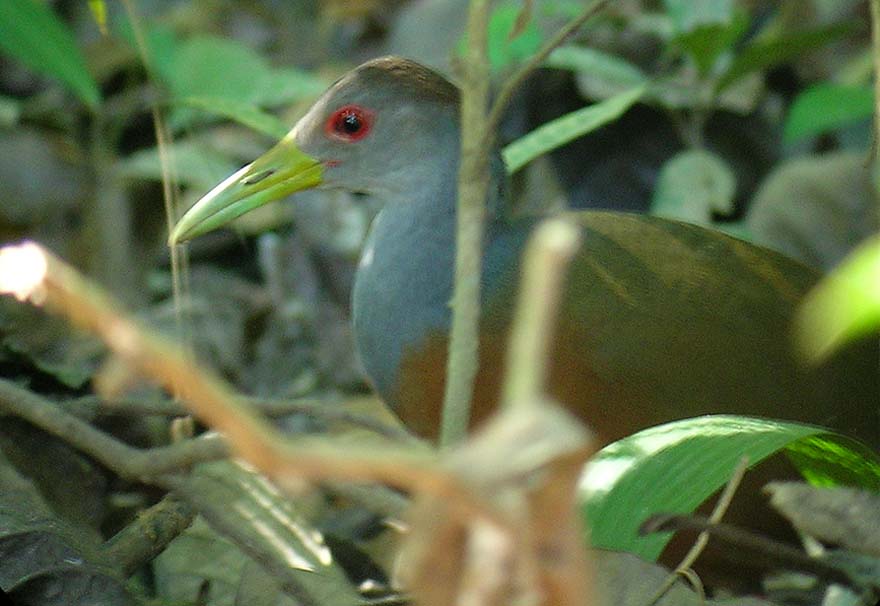
(linked bird photos courtesy of Richard Garrigues.)
The no-see-ums plagued us in the afternoons, when it was best to stay in the breeze, and my feet swelled up -- probably a combination of heat, bug-bites, and an overdose of margarita salt. Among the fish at Isla Caño was a white, speckled eel and a parrot fish that watched me warily when I dived down among them.
At night, after watching the sunset from a bluff the boys chased the red-orange eyes of nightjars -- the compact hawks would unfold surprising wings, flutter a dozen or score feet away and light once again in the grass -- and I could see why the local grandmothers warn the children not to follow the nightjars, for they'll tempt you off into the jungle to be lost forever.
We stayed there from Monday to Friday, when we retraced our path back through the mangroves to Sierpe and then on back toward San Jose.
We headed out again on Sunday, this time just Monica, the boys and I. We drove Clara's car up into the high country, past the cedar woods or Zarcero through Ciudad Quesada (which everyone calls San Carlos). At every corner in this country of horse and cattle there were melons and yucca blossoms and other fruits for sale. We stayed at the Termales del Bosque -- the hotsprings of the forest.
In the fields where the path to the hotsprings starts there were red deer, and grey-necked wood rails foraging in the grass. You descend down a wet path (because it had begun raining and the canyon is filled with jungle) to the spring fed pools along the creek. There you can find the pool with the temperature to suit you -- the hotter ones are those closest to the source, of course -- and you soak.
On Monday Porter and Monica rode horses in the rain and fog. They saw keel-billed toucans. As for Nico and I, after he had watched some cartoons in Spanish we walked. Then we all gathered all our things from our little bungalow and made our way back down to the pools. The rain fell harder today, but if you are going to have a rainy day during your vacation then hot springs are the place to schedule it. We lingered far longer than we had planned.
We traveled on to the foot of the Arenal Volcano. Supposedly, it is the most dramatic and active of all of Costa Rica's volcano, but mostly there was rain and fog and howling winds -- and vistas of the huge Lago Arenal with the heavy clouds torn above it. Still we hiked up the hills.
The next day we circled the lake a drove out of the lush basin of the lago and into the parched heat of dry-season Guanacaste. The dessicated fields, leafless trees and herds of gaunt brahman cattle reminded me of India's Rajasthan more than anything else. If the rock outcroppings would have had ruined hill forts upon them the illusion would have been complete. Across the Nicoya Peninsula we headed for Playa Samara, a classic beachtown on the Pacific coast. And so it was sandcastles decorated with coral and swimming in the surf. (I found that I had crossed some line in birding-geekdom when I ignored a full troop of howler monkeys in the mangoes and spent 5 minutes concentrated on figuring out whether the bird in the weeds was an Olive Sparrow or a Worm-Eating Warbler. -- Its conical bill gave it away as the sparrow.)
We spent the last couple of days back in San Jose, doing some eating out and some shopping and some video-gaming and some good hanging out with Eckart and Clara and Sophia. On our last day I made a morning run down to Carara National Park for a final hike (crocodiles! peccaries! iguanas! monkeys! macaws! -- and I identified 46 species of birds that morning, including pale-billed woodpeckers, trogons, manakins, herons and motmots).
And as I said, it was a pretty good trip to Costa Rica. And nice to be home, too.
Thursday, March 18, 2010


Wednesday, March 17, 2010


Tuesday, March 16, 2010


Monday, March 15, 2010


Sunday, March 14, 2010


Thursday, March 11, 2010
Every civilized country (even our own) recognizes that there is a common benefit when more of the population has access to good health -- whether that benefit is moral, economic or whatever. Because of our fear of government and our fetish for capitalism-in-all-things we've built a system which manages to harness the worst of both worlds to create a mess.
On the one side is government regulation at its clumsiest -- that is rather than incentivizing behaviors that promote the common good, government policy regulates directly against the incentives built into the system (profits) in favor of something else (care); it asks corrupted politicians to choose between the needs of constituents and corporate donors; all transparency is lost in a mishmash of state and federal regulations.
On the other side is the worst kind of capitalism -- heavily monopolistic rather than market in almost all cases; a morass of heavy regulation and cronyism that favors the biggest, best connected companies; and profits that increase in direct proportion to amount of human suffering caused.
The only arguments that I hear for keeping this system are that it's unfair to insurance companies (!!!??) or that government can't do it -- neither of which hold any water as far as I'm concerned. The US is suffering from a severe case of insurance-industry-induced lack of imagination and can-do-itiveness.
Here's a chart that shows how we get the least return on our health care dollars -- and how much of an outlier the US is as a result of our dysfunctional system (click on figure to expand):

Monday, March 8, 2010
On writing, from an interview with the poet Chris Abani:
Percival Everett took me to Barnes & Noble. He walked me over to the fiction section and said, “Pull out every tenth book and read the first two pages….separate the books into three piles based on the following questions: Which books are important and inevitable? Which books are good? Which books are bad?...”
[When] I was finished, I realized that I had about four books in the “important and inevitable” pile. These were books that just had to be in the world.
…
And so at the end he said, “What you should be asking yourself is not Will I get published?...What you should ask yourself…is, Can I write something important? Can I write something… inevitable?” Well, I asked Percival, “So how do you know?” And he said, “You will know what is important and inevitable because it’s the story that keeps you up at night. It drives you crazy. It makes you angry. It makes you despair. It makes you depressed. Because all of that will pour into the book and go into the world, and people will read it and say My life has been changed.”
…
And so at the end he said, “What you should be asking yourself is not Will I get published?...What you should ask yourself…is, Can I write something important? Can I write something… inevitable?” Well, I asked Percival, “So how do you know?” And he said, “You will know what is important and inevitable because it’s the story that keeps you up at night. It drives you crazy. It makes you angry. It makes you despair. It makes you depressed. Because all of that will pour into the book and go into the world, and people will read it and say My life has been changed.”
Monday, March 1, 2010
Thursday, February 25, 2010
-
Most of our work is about giving communications advice to non-profit advocacy groups. Some of that disappears into the bowels of organizations never to be seen again. So it is satisfying to catch it when it actually emerges out into the world. Our work on the "ripple effect" that the arts have has been getting a good deal of circulation.
Last year we did research for the Union of Concerned Scientists to help with their efforts to move the US away from its reliance on factory farms. (Actually, one of our recommendations was to not use the term "factory farms" at all, but instead to use the technical term, CAFO.) A letter to the editor in today's New York Times is a perfect encapsulation of the kind of message that we helped them craft -- to reach the audience that they need to persuade.
The letter was in response to an appalling editorial about how we should deal with the cruelty of CAFO's by engineering animals that feel less pain.
To the Editor:
Given that our current system for producing meat inflicts pain on animals, the sensible response is to change the system, not the animals. Adapting food animals to an admittedly cruel system is a poor use of advanced scientific knowledge, especially since we are not “stuck” with the confined animal feed operations, or CAFOs, that dominate our current system. Smart pasture operations raise cows on pasture, which is what they are built to eat. The same pasture operations that make for contented cows also protect air and water quality, sequester heat-trapping carbon and don’t undercut the efficacy of valuable human antibiotics. Eventually the price differential between CAFO and grass-fed cows will decrease as pasture-intensive operations scale up. Instead of engineering animals to adapt to pain, we should focus on moving now toward food production systems that are good for people, food animals and the environment.
Mardi Mellon
Director, Food and Environment Program,
Union of Concerned Scientists
Washington, Feb. 19, 2010
Most of our work is about giving communications advice to non-profit advocacy groups. Some of that disappears into the bowels of organizations never to be seen again. So it is satisfying to catch it when it actually emerges out into the world. Our work on the "ripple effect" that the arts have has been getting a good deal of circulation.
Last year we did research for the Union of Concerned Scientists to help with their efforts to move the US away from its reliance on factory farms. (Actually, one of our recommendations was to not use the term "factory farms" at all, but instead to use the technical term, CAFO.) A letter to the editor in today's New York Times is a perfect encapsulation of the kind of message that we helped them craft -- to reach the audience that they need to persuade.
The letter was in response to an appalling editorial about how we should deal with the cruelty of CAFO's by engineering animals that feel less pain.
To the Editor:
Given that our current system for producing meat inflicts pain on animals, the sensible response is to change the system, not the animals. Adapting food animals to an admittedly cruel system is a poor use of advanced scientific knowledge, especially since we are not “stuck” with the confined animal feed operations, or CAFOs, that dominate our current system. Smart pasture operations raise cows on pasture, which is what they are built to eat. The same pasture operations that make for contented cows also protect air and water quality, sequester heat-trapping carbon and don’t undercut the efficacy of valuable human antibiotics. Eventually the price differential between CAFO and grass-fed cows will decrease as pasture-intensive operations scale up. Instead of engineering animals to adapt to pain, we should focus on moving now toward food production systems that are good for people, food animals and the environment.
Mardi Mellon
Director, Food and Environment Program,
Union of Concerned Scientists
Washington, Feb. 19, 2010
Subscribe to:
Posts (Atom)