Monday, March 29, 2010


It was a good trip to Costa Rica.  We got to stay with Clara and Eckart and Sofia (who's nearly 6 now!) in San Jose.  And they all came down with us to the Osa Peninsula for a few days.  It's not one of the most accessible parts of the country.  In fact, you can only get to most of it by boat -- in our case an hour down the Sierpe river through one of the world's great mangrove forests, out to the Pacific and then a beach landing below Casa Corcovado on the borders of the national park.


We didn't stay at the hotel, but at the house of the owner, Steve, a friend of Clara and Eckart's.  He's a guy from Chicago who rode a barge down in the early 1970's and stayed. Carved a living for himself literally in the jungle and now owns a beautiful lodge that he's built there.  And he's proud that he's the only hotel in Costa Rica to receive the highest rating from the country's sustainable tourism program.  To us he was a generous host, not just sharing his house on the beach, but feeding us at the restaurant, leading us on a hike to the Pedrillo River in Corcovado National Park, taking us snorkeling on the coral reef at Isla Caño, and helping the boys with their sand castle engineering efforts.  


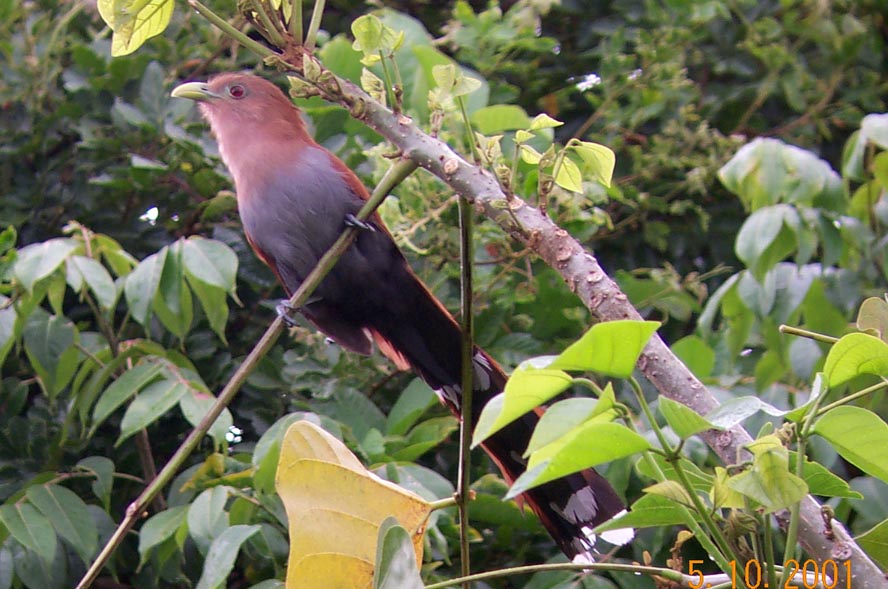
Scarlet macaws dropped beach almonds on the boys heads as they played, the mangrove hawks keened, capuchins and spider monkeys disputed over a fruit-bearing tree, while we sipped our beers.  Toucans, trogons, honeycreepers and cuckoos were in the trees.  Magnificent frigate birds and brown pelicans cruised the coastal air currents and a million hermit crabs streaked the sand.  Coatis snuffled along the verges.  Long-billed Hermit hummingbirds sipped from the long native blossoms, but the little banaquits nipped the flowers' base to steal the nectar.  Jungle plants, down in the gloom with us fought for their drops of sunlight and army ants scouted among them.  Porter spied agouti foraging silently and we all swam in the waterfalls of the San Pedrillo despite the false coral snake in the rocks. 
(linked bird photos courtesy of Richard Garrigues.)


The no-see-ums plagued us in the afternoons, when it was best to stay in the breeze, and my feet swelled up -- probably a combination of heat, bug-bites, and an overdose of margarita salt.  Among the fish at Isla Caño was a white, speckled eel and a parrot fish that watched me warily when I dived down among them.  


At night, after watching the sunset from a bluff the boys chased the red-orange eyes of nightjars -- the compact hawks would unfold surprising wings, flutter a dozen or score feet away and light once again in the grass -- and I could see why the local grandmothers warn the children not to follow the nightjars, for they'll tempt you off into the jungle to be lost forever.


We stayed there from Monday to Friday, when we retraced our path back through the mangroves to Sierpe and then on back toward San Jose.


We headed out again on Sunday, this time just Monica, the boys and I.  We drove Clara's car up into the high country, past the cedar woods or Zarcero through Ciudad Quesada (which everyone calls San Carlos). At every corner in this country of horse and cattle there were melons and yucca blossoms and other fruits for sale.   We stayed at the Termales del Bosque -- the hotsprings of the forest.  


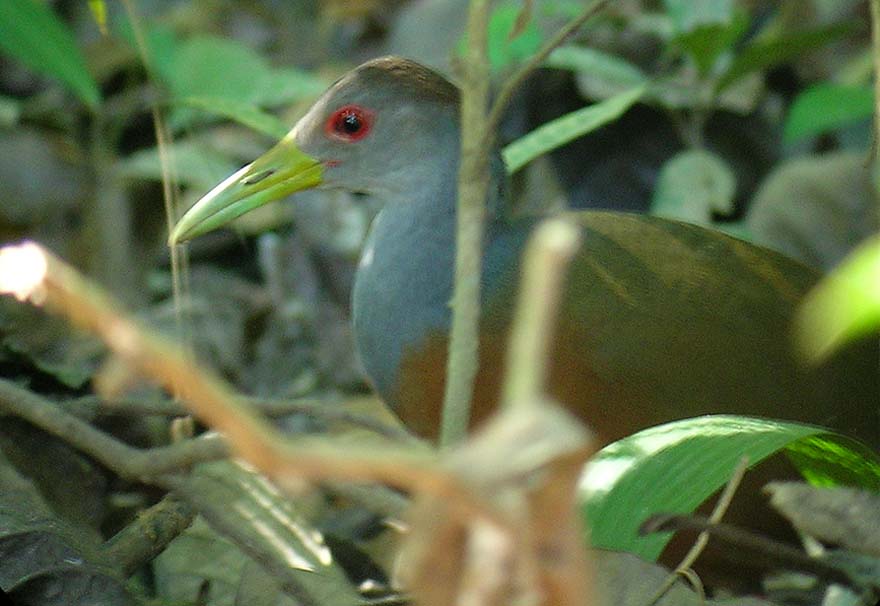
In the fields where the path to the hotsprings starts there were red deer, and grey-necked wood rails foraging in the grass.  You descend down a wet path (because it had begun raining and the canyon is filled with jungle) to the spring fed pools along the creek.  There you can find the pool with the temperature to suit you -- the hotter ones are those closest to the source, of course -- and you soak.  


On Monday Porter and Monica rode horses in the rain and fog.  They saw keel-billed toucans.  As for Nico and I, after he had watched some cartoons in Spanish we walked.  Then we all gathered all our things from our little bungalow and made our way back down to the pools.  The rain fell harder today, but if you are going to have a rainy day during your vacation then hot springs are the place to schedule it.  We lingered far longer than we had planned.


We traveled on to the foot of the Arenal Volcano.  Supposedly, it is the most dramatic and active of all of Costa Rica's volcano, but mostly there was rain and fog and howling winds -- and vistas of the huge Lago Arenal with the heavy clouds torn above it.  Still we hiked up the hills.


The next day we circled the lake a drove out of the lush basin of the lago and into the parched heat of dry-season Guanacaste.  The dessicated fields, leafless trees and herds of gaunt brahman cattle reminded me of India's Rajasthan more than anything else.  If the rock outcroppings would have had ruined hill forts upon them the illusion would have been complete.  Across the Nicoya Peninsula we headed for Playa Samara, a classic beachtown on the Pacific coast.  And so it was sandcastles decorated with coral and swimming in the surf.  (I found that I had crossed some line in birding-geekdom when I ignored a full troop of howler monkeys in the mangoes and spent 5 minutes concentrated on figuring out whether the bird in the weeds was an Olive Sparrow or a Worm-Eating Warbler.  -- Its conical bill gave it away as the sparrow.)


We spent the last couple of days back in San Jose, doing some eating out and some shopping and some video-gaming and some good hanging out with Eckart and Clara and Sophia.  On our last day I made a morning run down to Carara National Park for a final hike (crocodiles! peccaries! iguanas! monkeys! macaws! -- and I identified 46 species of birds that morning, including pale-billed woodpeckers, trogons, manakins, herons and motmots).


And as I said, it was a pretty good trip to Costa Rica.  And nice to be home, too.


Thursday, March 18, 2010

Wednesday, March 17, 2010

To Isla Cano to snorkel on the coral reef and build sand castles.


Tuesday, March 16, 2010

Monday, March 15, 2010

San Jose to the Osa Peninsula -- via Rio Sierpe and the mangrove forests.


Sunday, March 14, 2010


We arrived in Costa Rica to Clara, Sophia and Eckart.

Thursday, March 11, 2010


Every civilized country (even our own) recognizes that there is a common benefit when more of the population has access to good health -- whether that benefit is moral, economic or whatever. Because of our fear of government and our fetish for capitalism-in-all-things we've built a system which manages to harness the worst of both worlds to create a mess.  


On the one side is government regulation at its clumsiest -- that is rather than incentivizing behaviors that promote the common good, government policy regulates directly against the incentives built into the system (profits) in favor of something else (care); it asks corrupted politicians to choose between the needs of constituents and corporate donors; all transparency is lost in a mishmash of state and federal regulations.  


On the other side is the worst kind of capitalism -- heavily monopolistic rather than market in almost all cases; a morass of heavy regulation and cronyism that favors the biggest, best connected companies; and profits that increase in direct proportion to amount of human suffering caused.  


The only arguments that I hear for keeping this system are that it's unfair to insurance companies (!!!??) or that government can't do it -- neither of which hold any water as far as I'm concerned. The US is suffering from a severe case of insurance-industry-induced lack of imagination and can-do-itiveness.


Here's a chart that shows how we get the least return on our health care dollars -- and how much of an outlier the US is as a result of our dysfunctional system (click on figure to expand):


Monday, March 8, 2010

On writing, from an interview with the poet Chris Abani:


Percival Everett took me to Barnes & Noble. He walked me over to the fiction section and said, “Pull out every tenth book and read the first two pages….separate the books into three piles based on the following questions: Which books are important and inevitable? Which books are good? Which books are bad?...”

[When] I was finished, I realized that I had about four books in the “important and inevitable” pile. These were books that just had to be in the world.

And so at the end he said, “What you should be asking yourself is not Will I get published?...What you should ask yourself…is, Can I write something important? Can I write something… inevitable?” Well, I asked Percival, “So how do you know?” And he said, “You will know what is important and inevitable because it’s the story that keeps you up at night. It drives you crazy. It makes you angry. It makes you despair. It makes you depressed. Because all of that will pour into the book and go into the world, and people will read it and say My life has been changed.”

Monday, March 1, 2010


In the next room Porter is cracking up Nico with some nonsense.  It reminds me how Nico's first laughter was brought on by four-year-old Porter's clowning.  Porter would make a face or clap his hand to his head and Nico just thought that was the funniest thing he was ever going to see.

Thursday, February 25, 2010

-
Most of our work is about giving communications advice to non-profit advocacy groups.  Some of that disappears into the bowels of organizations never to be seen again.  So it is satisfying to catch it when it actually emerges out into the world.  Our work on the "ripple effect" that the arts have has been getting a good deal of circulation.


Last year we did research for the Union of Concerned Scientists to help with their efforts to move the US away from its reliance on factory farms.  (Actually, one of our recommendations was to not use the term "factory farms" at all, but instead to use the technical term, CAFO.)  A letter to the editor in today's New York Times is a perfect encapsulation of the kind of message that we helped them craft -- to reach the audience that they need to persuade.


The letter was in response to an appalling editorial about how we should deal with the cruelty of CAFO's by engineering animals that feel less pain.


To the Editor:
Given that our current system for producing meat inflicts pain on animals, the sensible response is to change the system, not the animals.  Adapting food animals to an admittedly cruel system is a poor use of advanced scientific knowledge, especially since we are not “stuck” with the confined animal feed operations, or CAFOs, that dominate our current system.  Smart pasture operations raise cows on pasture, which is what they are built to eat. The same pasture operations that make for contented cows also protect air and water quality, sequester heat-trapping carbon and don’t undercut the efficacy of valuable human antibiotics. Eventually the price differential between CAFO and grass-fed cows will decrease as pasture-intensive operations scale up.  Instead of engineering animals to adapt to pain, we should focus on moving now toward food production systems that are good for people, food animals and the environment.

Mardi Mellon
Director, Food and Environment Program,
Union of Concerned Scientists
Washington, Feb. 19, 2010

Tuesday, February 23, 2010

-
Porter turned twelve today and blew out the candles on a plate of lemon bars.

Here is part of a poem he wrote last year (with a little help from Judith Viorst):

If I were in charge of the world
I'd cancel tomatoes
Wednesday afternoons
Gross medication, and also
A certain middle-schooler.

If I were in charge of the world 
There'd be visible leprechauns,
Smarter guinea pigs, and
Ladder trees.

If I were in charge of the world
You wouldn't have ouch.
You wouldn't have dirty.
You wouldn't have bedtimes.
Or, "Time for lights out!"
You wouldn't even have lights.

If I were in charge of the world
Coffee ice-cream 
would be a vegetable.
All video games would be E
And a person who sometimes forgot to eat,
And sometimes forgot to think,
Would still be allowed to be
In charge of the world.


Sunday, February 21, 2010


At age 40 I could say I was half-way to 80, but turning 45, to say halfway to 90 seems overly optimistic.  So somewhere there I crossed that half-way point.  Still you never know.  The family tree is knotted with tough old Puritans and Scots farmers who lived well into their 90s.


We went out for breakfast at the Whistlestop cafe so Nico could watch the trains go by as he had his pancakes.  The crossing gates were coming down even as we pulled up in the car - so he and I got out to grip the chain link fence and we squinted through the ferocious wind and roar that Amtrak's Northeast Regional threw back at us.


A simple strawberry shortcake, split among the four of us served as my birthday cake.


In the evening we went over to Charles and Patty's and got in their way as they cooked us all a wonderful dinner of Indian food.  Beer was drunk; laughter was laughed; commensality ensued.  It was good.
.

Saturday, February 20, 2010


I saw a woman with a Modigliani face in a silver SUV waiting patiently, maybe mournfully, to turn past the little graveyard on Route 1 where the Dennison sea captains and their dead children lay 10 generations buried beneath stones engraved with weathered, winged skulls.

Thursday, February 18, 2010

hiatus

Phew, a month has passed as the blog has sat fallow.

I was off in Los Angeles for 10 days at the end of January -- doing ethnography for one of the unions trying to organize grocery workers, and managing a couple of other ethnographers, a videographer, and another anthropologist doing on-going phone interviews for the same project.  That set us hip-deep in data that we're still chewing through.

It was good to see Anna, Esperanza and Alberto, and I used Glendale as my base of operations.  They fed me well.

As that California project slips into the write-up and video-edit stages, I'm running point on the next phase of research, interviewing Walmart employees. (More on that later.)

In Rhode Island and Connecticut, unsettled weather has brought snow days and school delays.  Nothing like the blizzards they've gotten further south and inland, but Monica and the boys have been exploring the local ski slopes.  A few warm days have thinned the snow cover and it's patchy on the sunniest spots.  The rivers are running high.  A bluebird showed up yesterday morning, poking around in Nico's birdhouse.  The juncos hopped around looking at it as though it were an apparition.

I introduced the boys to GURPS, the role-playing game, and it became an immediate obsession.  Their characters bonded in their first tavern brawl - an important rite of passage in gaming.  And now they are starting out on a campaign to free some captive wizards in hopes of getting some magic items in reward.  Porter has a cat-man with powers of stealth and invisibility as well as a woman knife-fighter who teleports.  Nico has a red-headed fencer who shape-shifts to a fox and a female elven archer.  I'm running a pyromaniacal dwarf and a magic user to balance out the group.  It all waits on Porter getting ahead on his burden of homework.

Monica's been emailing back and forth with Clara settling the details of March's trip to Costa Rica.  We're getting antsy for travel.

Friday, January 15, 2010


Haiku from a winter's walk


Chill sun on limn-frost
dormancy of elements
broken by a breath


In snow-crusty wood
My steps crush weathered track of
 mink and deer and fox


Sunday, January 10, 2010


We shall not cease from exploring
And the end of all our exploring
Will be to arrive where we started
And know the place for the first time.

---- T. S. Eliot

Friday, January 8, 2010


The pursuit of truth is like picking raspberries.  
You miss a lot if you approach it from one direction.


-- Randal Marlin.

Thursday, January 7, 2010


This is a poem of Denver's that I forwarded to Monica,
because Neruda alway makes her pause . . . .


this is Pablo Neruda Avenue
she said
and unbuttoned the top button
of her jeans


may I walk along it?
he asked


only if you bring me
a line by Pablo Neruda
she said


he was silent for a moment


and then he said
The memory of you emerges from the night around me


whisper it
she said


and he whispered it
as evening fell
on Pablo Neruda Avenue

Wednesday, January 6, 2010