Showing posts with label bees. Show all posts

Thursday, February 18, 2016

Wintery interlude


Midway through a too-mild February 

(coaxed-up shoots of daffodil and snowdrop)

 a pair of snowstorms and arctic blast return us brutally to winter:


16 below zero, then to 10 above in breezy daylight, 

and back to 12 below.  

Wind chills range the minus thirties.

 I feed the birds when these blasts come

(juncos, cardinals, sparrows, titmice, chickadees, jays, doves, finches, and woodpeckers)

and regret the thick beard I shaved away.


The old beekeepers say the stronger colonies will survive 10 below.


Saturday, July 18, 2015

A Summer Honey Harvest

One of the girls on butterfly weed
I took some summer honey off the high hive today.

They'll keep two deep boxes and a medium for their winter lodgings, but that leaves another three boxes on top.  One was full of capped honey, one was mostly full of nectar and uncapped honey, and in one they are drawing comb - though in no rush about it yet.

a frame of capped honey
I took off the heaviest box and removed the frames - gently brushing off the bees.  It was a cloudy, breezy day, but the bees were placid - except for a few gung-ho guards, who resented the disruption.

I placed the frames into an old Coleman ice chest that I pilfered from my father long ago - and lugged them inside.

The last time we harvested, two years ago, was during the dearth and bees besieged the house, drawn by the scent of honey.  Today, with flowers still in bloom, they had other places to be.

We scratched off the caps and placed the frames into the extractor - a hand crank centrifuge that lets you spin the honey out of three frames at a time.  


Into the extractor.


Porter turns the crank.


 Straining out the beeswax,


and 30 pounds of honey sits in the jar. 


Sunday, May 17, 2015

Ending a Hiatus

Mingo County, West Virginia
Hmmmmm.

2 posts in the past two months.  I'm not sure that counts as maintaining a blog.

I've kept journals pretty consistently since I was 14 or so.  Sometimes they lapse, usually either because I find myself too uninteresting to be worthy of record, or because I'm caught up in too many other things and the backlog of potential entries starve each other.

These last two months have been more that second problem.

At work we've been busy beyond our capacities - and as research director it's been my job to keep projects rolling that explore how different people conceptualize and think about: good governance, mental disability, the transition away from coal in Appalachia, the earned income tax credit, family work balance, taxation, and money in politics.

Welch, WV
There've week-long been research trips - to central Appalachia on the coal project and California for money in politics.  I leave for Kansas City on Friday.  There has been phone interviewing, both by me and by people I've been training - on money in politics, the EITC, family work balance, etc.  I've been training assistants to handle our on-line experiments at testing communications strategies - for governance, taxation, and others, but there are a lot of moving parts.  And recruiting an extra ethnographer or two for upcoming research in Philadelphia.

With so much data coming in, analysis and writing has been the bottleneck, and it's been a high priority to get me back into the thick of that.

Carpinteria, California

In California, Porter is finishing up his junior year of high school, which these days means college visits.  So, when he came back from boarding school on his spring break in March we traveled to Maine to see old friends, but also to visit the Colby-Bates-Bowdoin triangle.  Plus MIT, Worcester Polytechnic and Brown.   Only a few weeks later we all went out to visit him on Family Weekend at Cate - meeting his teachers and advisor and seeing him perform in his chorale and camerata, and in the school musical - (he was the policeman in Singing in the Rain).

I've sworn to not neglect the garden.  Sunchokes have been dug up and pickled, the garden tilled and planted with potatoes, beets, and parsnips.  Chard and fennel overwintered and are growing again.  Mustard and cilantro seeded themselves, and I've planted more - as well as little patches of basil, parsley, broccoli, greens, leeks and tatsoi.

Monica came home with a few starts of cabbage and cauliflower, and though I doubt I'm diligent enough to save them from the caterpillars, I've planted them.  I even loaded some dirt onto the high hugel and put in some squash seeds.  Asparagus is up, though sadly I've only spied a single morel. Still to go in are the tomatoes, hot peppers and eggplants.


Asparagus and chard
My sad little peach tree didn't come back this year.  The root stock has put out some suckers, so I cut the top off and let it be.  The cherry is in leaf and I pulled off a few dozen caterpillars (winter moths, I suspect).

The apple trees put out blossoms, but whether they will set any fruit this year is anyone's guess.  The little crabapples seem to have evaded the deer, and only one of the plum trees took damage.  Other than giving them some water and checking to see if the Japanese beetles have arrived yet, there's not much labor there.

And the beehives are abuzz.


Sunday, April 12, 2015

The bees re-emerge.

The first three winters of my beekeeping career I failed utterly to coax a hive into over-wintering.  They all absconded, starved or otherwise expired before the spring nectar flow.  (0 for 7, I think.)

Part of that comes from my general approach to these kinds of things - which is to see how little I can get away with doing, before I start following all of the complicated edicts from the experts.

But my two colonies have successfully survived the winter and are currently finding nectar and pollen somewhere.  All I see around me are crocuses, snowdrops and the odd periwinkle blossom, but I suspect they are off to the swamp visiting the skunk cabbage.  They are already putting up nectar.

The smaller of the colonies I've written off as dead at least three times - first, last April when I accidentally uncaged the new queen directly into the hive - second when I checked back a few weeks later and found no brood at all - and third when I peeked in during the winter and found the too-light hive quiet and apparently empty.  (I only looked in the top - but in the other hive bee activity was high in the hive and obvious.)  I've never been able to spot this zombie queen that seems to keep bringing things back to life.

To myself I call that hive Corinth and the bigger, more vigorous hive Athens.

Last summer the nectar flow failed and not only did I harvest no honey, but in the fall I fed the two colonies something like 75 pounds of sugar just to give them some winter stores.  And yet this is the first lot of mine to survive.  Go figure.

Sunday, October 5, 2014

Tending to things


Before the sun clears the trees there is an autumn chill in the air and the bees looked cold and clustered this morning when I opened the top to remove some empty feeding jars.  I tipped the hives gently and they felt good and heavy.  They ought to be.  Neither colony put away honey this summer, but in the past few weeks I have fed 120 lbs of sugar to them in the form of heavy syrup.

 I looked over the late remnants of my garden - an abundant crop of green tomatoes that will never ripen now, I fear.  Nearly all of my other vines have long since withered, but the deer kept this one pruned most of the summer, which seems to have made it green and vigorous.  A little garter snake was there glistening in the sun, but clearly he's not keeping enough of the slugs at bay.

withered brown-eyed susans
More of the Thai peppers are still ripening.  I already have a hot sauce in the cupboard and there should be enough to experiment with another and still have peppers left over for the winter's kimchi.  One of my few successful crops this neglected summer.  That and peppermint.  I have three quart jars full of dried peppermint for making tea.  A bit of sage, basil and oregano dried as well.

The fall greens are doing well, though the grasshoppers are starting to hit them hard.  Maybe that will finally motivate me to take the butterfly net and harvest some to toast up.  They scatter with every step in the un-mown grass.

I pulled apart an empty beehive that I had left to sit all summer, and of course half the comb was wrecked by mice and moths and the rest was inhabited by spiders and earwigs.  I set it all in the sun in case any birds or wasps wanted to help me clean it out.  The phoebes and a family of bluebirds were lingering here last week, but I think they have moved on.

Ducking back inside, I put myself on a half-hour timer on the laptop, so I wouldn't while away too much of a pretty day.  Catching up on the too-many blogs I read, writing on my own, checking the news.  I added my two cents to an Ebola thread at the Archdruid Report.

I helped Nico pack for his school trip this week.  They'll be in Washington DC from Monday to Thursday.  I got him oriented on our little point-and-shoot camera.  Through the window he spied fat wood frog trapped in a bucket of rain water and went out to free it.

small milkweed bug nymphs congregating
Afterward I walked into the woods in search of hen-of-the-woods, but it's been a dry year and fungi were few.  I didn't see any of my quarry, but I also saw no tell-tale signs of any being harvested.  Either they are late or not fruiting this year at all.  The nuthatches and titmice were in an uproar about something.

On my laptop I listened to most of the early football game.  Sometimes I'll go in to Westerly to watch a game at the bar, but I find I'm just as happy to putter while I listen.  My shop was all sawdust and chaos, so I brought some order to it. And my team won.

No birds were helping clean out the beehive, so I settled down in the grass with my hive tool and began scraping and cutting.  I had gone to a biodynamic beekeeping workshop yesterday put on by Gunter Hauk.  I take his Rudolf Steiner mumbo jumbo with a grain of salt, but I'll listen to any beekeeper with 40 years of experience, and Herr Hauk is clearly a thoughtful and observant bee man.   As I snipped and pulled old comb out of the frames, I considered which of his techniques I'd adopt.  Doing without foundation, for one.  I'd reassemble these frames without wired foundation, or rather just a little starter strip at the top.  Raising my own queens obviously.  But for that I need to get these colonies through the winter.  Formic acid treatments for varroa mites, certainly.  Making a charm out of varroa mite ash and using dowsing to inquire into the hives?  not so much.  The next time I have to feed sugar, I'll use his recipe and mix in some of their honey and some chamomile.
small milkweed bugs

I took the old comb over to the fire circle, which reminded me that I have been meaning to clear the ash out, since it is beginning to form a bit of a mound.  I dug out three wheelbarrow loads and shoveled them onto the big hugelkultur, which has been swallowed by vetch.  I figure winter rains will wash the ash and charcoal down into the body of the hugel.  In the spring I'll cover it with more dirt from somewhere and plant on it.

I need to finish digging out the last of my paltry potato crop and ready a bed for planting garlic.  I need to stack three cords of wood that are sitting in a pile and put on the storm windows.  I'll get to it.  Now it's time to write in my journal and toast the year's impending dormancy with a glass of whiskey.

UPDATE:  in an early version I had mislabeled these insects as boxelder bugs, but a reader pointed out that they seem to be small milkweed bugs instead.

Friday, June 27, 2014

Bad Beekeeping

_

One of the casualties of my busy spring has been any pretense at competent beekeeping.  On May 8th I managed to pick up a couple of packages of bees only a few hours before I was heading off for two and a half weeks.  I hurriedly installed them in the hives I'd prepared and as often happens when you hurry, I made a mistake.

The bees that arrive in a package are not a true colony.  It contains a mated queen and a random collection of workers which are vacuumed out of the air at a breeder complex.  4 or 5 thousand of them are put in a small box with a kind of paint can full of sugar syrup that has a few holes poked in it.  The bees form a swarm around the food source.  Although the bees are from many different colonies they don't molest one another, but if you introduce a strange queen to this motley collection they will attack her and kill her.  The workers need a week or so of exposure to her pheromones before they will accept her as their own queen.

For this reason the queen is put in a queen cage.  Three little conjoined chambers are routed out of a little block of wood and a hole drilled in either end.  One chamber is filled with "candy" a sugar paste.  The queen is placed in the neighboring chambers with a couple of attendants, a scrap of screen covers it and both holes are corked shut.


The idea is that you do a "slow release" of the queen when you get her.  The main box of bees you disassemble and dump into a hive.  You remove the cork from the candy side of the cage and suspend it in the hive.  The bees will stay in a hive with the queen and the candy plug allows the bees to eat their way in to her over several days.  By that time, they will have accepted her and settled into their new home.  As she starts laying eggs the workers will feed and tend her brood until they reach adulthood themselves.


But as I said, I was in a hurry, and I removed the wrong cork, releasing her directly into the hive days earlier than planned.  I couldn't see what happened to her in the confusion of bees, whether they balled around her and killed her, so I closed up the hive and hoped for the best.

It was May 28th, three weeks later, when I next could look in, and there was no sign of a queen, no sign of any brood (that is larva or pupae) that would be in evidence if a queen were present.  I did note that they were constructing "queen cells", which is something a colony will do if the queen is dead or dying.  But if there are no larvae a colony can't make a new queen.  It didn't occur to me to examine the queen cells closely.  I assumed that the remaining colony were simply the package bees, which would continue to work at bringing in nectar until they gradually died off.

Fast forward to June 23nd, nearly 7 weeks after I'd fumbled the hiving.  I saw there was still some traffic in and out of the hive, but assumed it was the successful colony robbing out the honey from the dead one.

Capped brood contain pupae and the open cells white larvae

But it turns out there is a small colony inside with brood and a healthy supply of nurse bees looking after it.  Somehow I must have missed something in that first hive inspection.  Maybe the queen was a slow starter.  Or, given the small size of the colony, maybe the original queen only survived long enough to lay a few eggs, which the workers nurtured into a new queen, who took a mating flight and is now building up her colony.

She's in there somewhere, though I didn't manage to spot her.  I'll look again and see if she has the little spot of paint that the breeders usually put on.  Until then, it's a mystery.

Saturday, January 25, 2014

I love January - 19th to 25th

-
I love a joke well-told.

I love the solving of a riddle, that moment when the rigid, false facade collapses and an unexpected figure strides smiling forth.

I love:

the migration of birds

the orioles squabbling in Costa Rican palms while juncos forfeit their taiga to claim these rich south woods of winter.

the dormancy of things that stay - creatures burrowed deep to sleep.

the fierce biding of stemless roots and leafless twigs.

the genius of a queen bee, hot within her cluster, sipping summer's honey.


 . . . The whole love poem below the fold . . .

Saturday, January 4, 2014

Six degrees below zero

_

It was bitter cold this morning - six degrees below zero as the sun came up.  

I own a pair of boots that I wear only a few days each winter - usually when I shovel snow.  Even with their thick woolen inserts they fit too loosely for walking far - unless I wear wool socks as well.  I own this pair of boots for the rare morning like this one.

wintering hives
The snow is a dust that has forgotten it was ever water.

The rhododendron leaves have drawn themselves down in tight coils, as if the plant were squinting against the cold.  

The only tracks across the whiteness are from birds among the weed-tops and a lone deer, who browsed a long path through the yard, nibbling cedar and pruning the cherry.  

I can hear a woodpecker pounding dully on the oaks.

I'll put out birdseed, which I haven't done yet this winter, but this is the kind of cold that can kill even the juncos and chickadees if their energies fail.  

And I'll sweep the little drifts from the beehive entrances, though no bee is going to try to venture out.

tree shadows on the snow


Thursday, December 5, 2013

December bees

_
It was a drizzly 54 degrees this afternoon and the bees were flying despite the damp.  All three hives seemed pretty active, which was good to see.  Last year, two of my colonies had already vanished by this point.  I didn't crack open any of the hives, but left them well enough alone.  Here's hoping they get themselves comfortably back into their clusters for the next wave of cold weather.
_

Sunday, November 3, 2013

The Cold of November

_
The basil and pepper plants were already done in by earlier frosts, but a hard freeze tonight will probably do for the rest.  I pulled the parsley, and cut some white sage and mint for drying.  I considered taking some oregano, but we rarely use it, and it seems to bear the cold just fine if I want to steal a winter leaf or two.  This year we planted rosemary and thyme in a pot.  I brought it in and set it before one of the windows.

There was a row of potatoes that I'd never dug, so I harvested those last few pounds.  The stalks had died back in July, so not only were the potatoes mostly smallish, but I had to guess at where the row was.  That meant the more than usual fell victim to the spade.  I won't have to worry about the potatoes lasting the whole winter this year.  We'll eat them up by New Years.

As the temperature dropped today the bees finally stopped flying.  I fitted in mouse guards at the lower entrances of each hive to make sure that none invade as the bees form their clusters.  I've also realized that only one of the hives has an upper exit.  If the warm, damp air that rises from the bees can't escape, it hits the cold cover, condenses and can rain cold water back down upon bees.  So next week on the warmest day I'll have to remove the inner covers and cut a 3/4 inch slot in each.  

I feel like I'm finally battening down the hatches for winter's approach.
_

Thursday, October 17, 2013

Honeyguide Bird

_
image by Colin Beale
There is a species of bird in Africa called the greater honeyguide (Indicator indicator), which likes to eat beeswax, the only vertebrate to do so.  It will also eat bees, bee larvae, and wax moths if it can get access to an open hive.  But it's a small bird and beehives are notoriously well-defended, so the species has a unique adaptation.  It knows every hive in a 200 mile radius.  If it finds humans within a few kilometers of a hive it will fly up to them, calling and flitting back and forth, flashing its tail.  If the humans are willing to grab an ax and follow the bird, it will lead them to the colony.  (Some traditional African honey-hunters blow a loud whistle, called a fuulido before they set out in search of honey in order to solicit a honeyguide.)  Once the humans have broken into the hive (usually a hollow tree) the bird can feast on the wax and the grubs.

The behavior is innate rather than learned - an evolved behavior.  By analyzing the difference between subspecies scientists calculate that the behavior is at least 3 million years old.

There are two theories about how it came about.  The first is that it co-evolved with the honey badger, who will use their claws to tear open a hive if they can find one.  But in 30 years of trying scientists have never been able to observe the birds interacting with a badger, so they remain skeptical.  A honeyguide was once observed to solicit baboons, but the baboons weren't interested.

The other theory is put forth by the anthropologist and primatologist Richard Wrangham.  He believes that the behavior evolved with human ancestors.  Wrangham's primary interest is in human evolution, and in particular he believes that the most important innovation which enabled the development of Homo sapiens was the mastery of fire.  He studied chimpanzees and noted that they spend fully half of their waking hours chewing.  He himself tried and failed to subsist on their raw diet.   The ability to cook food frees up nutrients that are otherwise inaccessible and this increase in the amount and quality of nutrients allowed human evolution to take it's unique path -- a shrinking digestive tract and a shrinking jaw, but most importantly that large, extremely energy-intensive brain.  

Cooking food is what enabled our human ancestors to support and feed those ever larger brains, and gave them the time and energy to be human.

But hominid brains have been growing for over two million years and there is no archeological evidence of fire use back that far - so Wrangham isn't able prove that cooking had anything to do with kicking off brain growth.  

This is where the greater honeyguide comes in.  Wrangham observed that chimpanzees love honey, but can't get it.  Humans love honey, and they can get it.  The difference?  Fire.  The use of fire and smoke is universal among honey hunters to confuse the bees and derail their defensive behaviors.  If honeyguide birds have been bringing humans to beehives for three million years, then it stands to reason that humans and their ancestors have probably had fire for the past three million years to help them despoil the hives.

It's not an air-tight case by any means, but I love this story of a magical partnership between a meddlesome wax-eating bird and these honey-loving, torch-wielding hominids - a partnership that has stood the test of a whirlwind millions-years ride from ape to human.
_

Sunday, October 13, 2013

Bald-faced Hornets and other Yellowjackets

_
wikipedia
This summer, I've noticed the occasional bald-faced hornet (Dolichovespula maculata) at the compost heap or checking the beehives for weaknesses, but so far the hives all seem robust enough to dissuade any wasps from making real forays.  When I first noticed them, I checked back behind the quince bushes and there was the nest - smaller than a basketball, but bigger than a volleyball.  Every second or third year a colony builds there.  Maybe a young queen is attracted to some invisible sign that a nest has prospered there in the past.

We call them hornets, but they are actually a species of yellowjacket, but twice the size of other yellowjackets and sporting white rather than yellow.  Like their cousins, a single queen hibernates through the winter underground or in a crevice somewhere.  The young hornet queen emerges in the spring and starts making the paper nest and rearing a first generation of sterile workers.  These take over building the nest, foraging, feeding the next generations of larvae, protecting the colony, and so on.

Hornets Nest
At the end of the summer, the queen rears a generation of drones and virgin queens, who will fly forth and mate.  Only these newly mated queens will overwinter.  The rest die off and the nest is abandoned, never to be re-used.

The big, papery globes are a dramatic structure to find in the woods - especially compared to other yellowjacket hives, which never appear as anything but a hole in the ground.  I had assumed the smaller cousins just dug burrows like ants, until a few years ago I had a colony that chose to live under a log right by the front door.  One night I took a can of bug spray, (left by the house's previous owners) intending to tip over the log and spray insecticide down the hole.  But when I turned the log, it came up with a torn, volleyball-sized paper nest.  I was glad I'd approached it at night when the wasps weren't prepared, or the ensuing massacre could have gone the other way.

But generally, unless they build somewhere especially inconvenient I leave the wasps alone.   It's true that they make off with the compost meant for the garden (together with the jays, raccoons and deer), but they otherwise don't bother us.  If they take the occasional caterpillar from the garden, so much the better.  And besides, I think our unpainted outdoor furniture has never become splintery because we have the hornets and other paper wasps who come and strip off the outer layers of wood all summer long.

Yellowjacket Colony


Sunday, September 8, 2013

Harvesting the Honey

_

Just robbed the bees of some of their honey.  The thievery went quite a bit smoother than last year, when I was on a very painful learning curve.  The key to not getting stung seems to be to use a smoker, bang the bees off each frame in front of the hive (by striking the corner of the frame sharply against a rock or something else solid), tidy up the last stragglers with a bee brush, and have a bee-proof container standing right by to place honey-filled frames into - in my case an ancient Coleman ice chest that I borrowed from my Dad and never gave back.  It may also have helped that I did one hive on Saturday and one on Sunday, so only one was riled up at a time.

This time no stings, and for the most part I was working in a cloud of confused, milling bees rather than angry, hostile bees.

The harvest seems about the same as last year -- maybe a bit lighter.  But still something over 50 pounds of honey taken from two first-year hives.  One of my hives never even filled the first super, so I let them be.

Tomorrow I'll put the wet comb back on top of the hives for them to clean up and depending on how heavy the remaining boxes feel (with their winter stores of honey), I'll start feeding them a bit and check for mites.
_
The task now is to help them get prepared to survive the winter . . .
_

Wednesday, July 17, 2013

Bearding hives

_
In the summer's heat 

the bees emerge upon the front of the hive 

where they form a humming beard of bodies. 

The instinct cools the hive, 

and keeps the idled foragers 

(whose over-heated flowers have paused in their nectaring) 

from getting in the way of busy house bees.


Monday, July 1, 2013

Beekeeping Update: putting on supers

_
My three colonies are all building up at different rates.


The northernmost hive is the most bustling - and making full use of the current nectar flow.  The bees have filled two medium supers with honey, most of it apparently already capped. (Supers are the boxes that sit on top of the brood chamber - and from which I will steal the honey.)   I had to quickly add another box before they ran out of space entirely.  That was my second to last super, so if they keep going I'll either have to get my hands on the bee club's honey extractor or buy some more woodwork.  Into it I put my last two frames of drawn comb, 5 new frames with wax foundation, and 3 empty frames for them to just hang comb in.

The middle hive is also bustling, though they've only filled one super and are still working on drawing comb in the second.  That one I can leave well enough alone for now, I hope.

The southernmost hive is the laggard.  I did put a super on a couple of weeks ago, but the bees are not very active in it -- still outfitting the brood chamber below.  It's hard to examine inside, because I made a hash of things setting up.  In the bottom box I'd had some comb that bulged out and didn't fit, and another slot that was empty which they filled with comb.  Now it's all glommed together so it's impossible to really move the frames around to get a look.

Still I opened the top brood chamber to take a look and make sure there is plenty of brood.  Unfortunately, the second frame I pulled turned out to be a medium frame - I don't know why it was there - but the bees had diligently filled the several inches below the bottom of the frame with comb.  That tore apart as I pulled the frame out, so, yes, I could see there was brood there in the most unfortunate way possible.  I put it back, closed up and left them to repair the damage.  That hive I may not open again.  If they do put honey in the super eventually, I doubt I'll harvest it, but just leave it on for winter stores.

I'm not sure why there are such differences.  The flight path out of the beeyard tends to go off to the northwest, so probably the northern hive gradually accumulates more returning foragers.  Or that queen was a replacement and maybe she comes from somewhat different stock.  The southernmost colony is from a package that came two weeks later than the others, and has a queen that from the start didn't seem to lay eggs in the tight pattern that beekeepers prefer.  The colony has never seemed as active as the others.  But also, the hive is more tucked under the trees and in the shade.  Last year the colony in that hive was the first to expire, so I may relocate it next year.

Anyway, that's life on the beekeeping learning curve.  When you start a new colony from package bees (as I did for all three of these) you generally don't get much, if any, harvest.  But unless these bees decide to eat it all in the July dearth - it looks like there'll be honey to steal this summer.  
_

Tuesday, May 28, 2013

Update on the bees

_
I have three colonies of bees going strong in the yard.

For a noob-beekeeper like myself, it's worth having three colonies rather than one or two just so I can get a sense when something is off in one.

For the most part they all seem to be doing fine.  Plenty of brood and plenty of activity in each.  Though the southernmost hive is lagging behind.  

That queen was the last to arrive so there's that.  Still, she strikes me as an odd queen.  There's plenty of brood, but it seems more scattered throughout the brood chamber.  Whenever I've opened the hive I've never failed to find her (she's dabbed with a red dot of paint) and she is always on the move, always without any apparent retinue of attendants.  Maybe that's just her style.  Or maybe the old comb I gave her hasn't quite cleaned up to her satisfaction.  There was a fair amount of old pollen packed into it I think.

But the two stronger colonies now have their full brood chamber up (two deep bodies for one and three mediums for the other).  I'd been feeding them honey from last year, but that's about exhausted (or moved down into the brood chamber) and so I'll give them some sugar syrup while they finish outfitting their homes.  The weaker colony still hasn't filled out the single deep box I've given them, and I will definitely be feeding them until they gather momentum.

A skipper sips at the chives

Monday, April 29, 2013

Banning neonicotinoids

_
Good news for the bees!  Europe has banned the use of neonicotinoid pesticides for two years until scientists can show that they are not the culprit behind the collapse of the bee population.  In the US, of course, research into pesticides has been mostly out-sourced to the companies themselves, and although they are obligated to do actual science, they have little incentive to be aggressive or thorough about it. 
Worldwide sales of the pesticides total in the billions of dollars. Two companies that make them in Europe, the German giant Bayer CropScience and Syngenta, a Swiss biochemical company, have said they were willing to finance additional research, but that the current data do not justify a ban.
In the US the EPA was willing to sit on its hands and wait to see if any scientific insights spontaneously developed or whether bees would recover or go extinct.  I have a feeling a ban in Europe will tend to stimulate a greater sense of urgency for the chemical companies and their agricultural clients.  If they think their product is truly safe, then I think they'll want to settle the question sooner rather than later.  If they suspect their product is an epic environmental disaster and they were hoping to kick the day of reckoning down the road, then I expect nothing but lobbying and complaining from them.
Europe’s struggle with the question of neonicotinoids and bee health is being closely watched in the United States, where the pesticides are in wide use, and where a bee die-off over the past winter appears to have been one of the worst ever. Beekeepers and environmentalists are suing the Environmental Protection Agency over its approval of the products, which they claim were allowed on the market with inadequate review.
Bees are in short supply.  The Rhode Island Beekeepers Association couldn't fill the orders of everyone who wanted to purchase queens this spring.   I was fortunate to order early and eventually got the three colonies that I ordered.  Two seem to be successfully installed, and the third I'll check on in a few days to see if the queen has been accepted yet.

Now I just have to figure out how to keep them alive until the EPA stirs itself to life.
_

Tuesday, April 16, 2013

_
In Georgia last week it was cold where they raise the bees and so the virgin queens stayed home and didn't take their mating flights - (they call them virgin queens rather than princesses).  And what you are buying when you buy a "package" is a mated queen with enough random worker bees to help her raise her first wave of brood.  But the cold weather meant a shortage, and although I'd ordered three packages, I could only pick up the two.

On Saturday I installed the bees in the waiting hives -- each queen in a tiny cage with a few attendants.  If you let her out too soon the confused worker bees will kill her.  So the entry to the cage is plugged with a candy paste.  By the time the bees eat through it, a matter of a few days, they've adopted the young queen as their own, and she sets about laying her eggs in the new comb.

I checked on the hives today, and shook the bees off the cage in the first hive.   The queen was not yet freed, so I undid the cork and let her out to disappear into the swarm.  She has a bright red spot of paint upon her.  In a few days I'll look for her or at least look for signs of eggs.  That will mean we are launched.

In the other hive the queen and her attendant were dead, still inside the cage.  No idea why she failed, though it happens.  I may be able replace her if I can secure a mated queen in the next few days.  It becomes a race against time.  The bees, queenless, may drift next door to the other hive.  Even if they stay put, the clock is ticking on these worker bees.  They only live for six weeks, and already it is nearly a week since they were packaged in Georgia.  Another few days to get a replacement; another few days in the cage before they will accept her; and only then will she begin to lay eggs for a replacement generation.  How many of the workers will survive over the following weeks to nurture the larvae to be nurses for the expanding brood chamber?  Even when things go well, the population reaches a nadir in the transition from the dying original workers to the queen's new offspring.  This delay makes that nadir all the deeper and more precarious.
_

Wednesday, April 10, 2013

_


The bees arrive on Saturday.  

The maple trees have been making pollen.

I took a little brown tree frog away from the cats.


 _


Friday, March 29, 2013

_

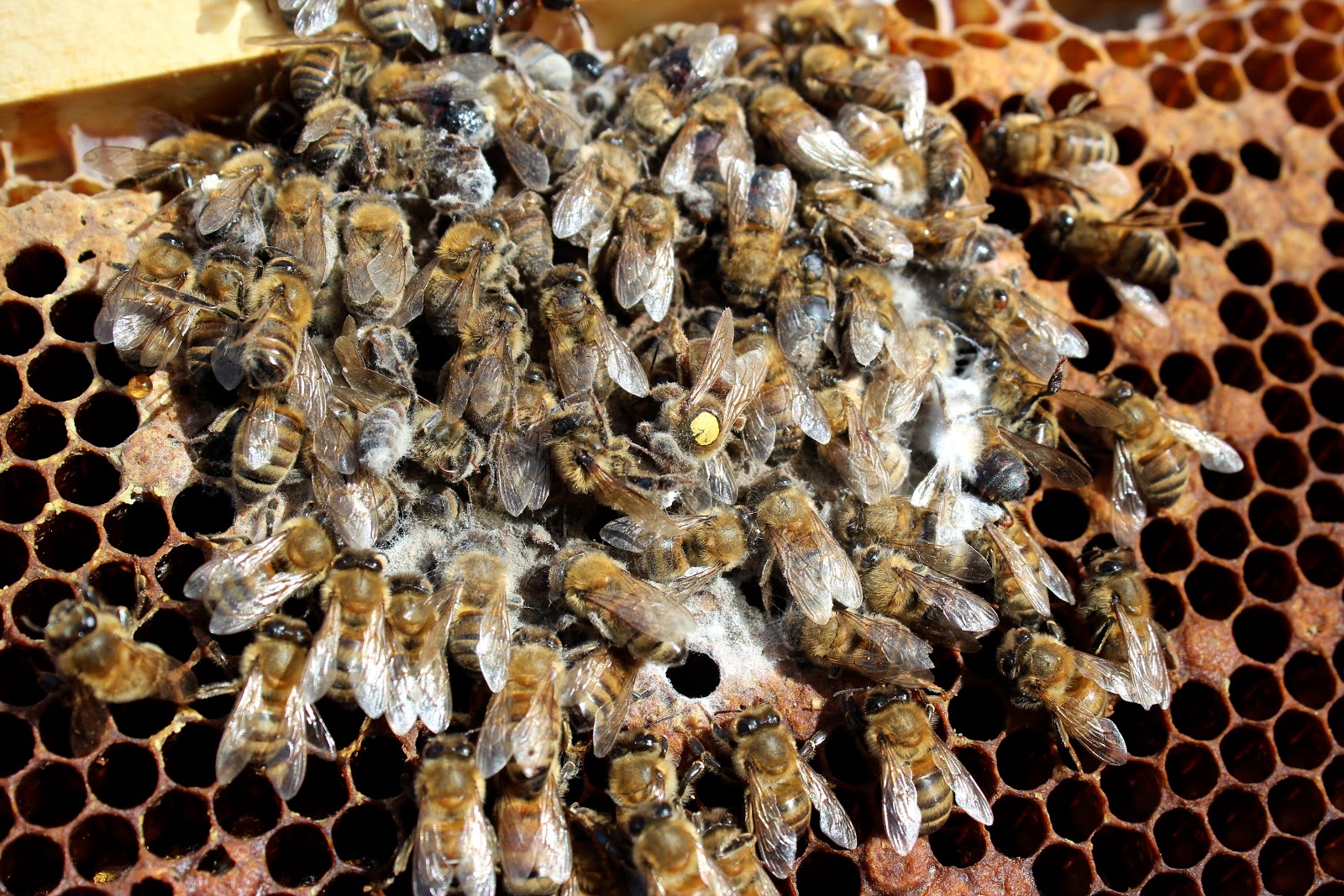
It's been a tough year for bees.  Colony collapse.  None of my three hives made it through the winter.  Two of them were abandoned before winter even set in.  The third was gone by the time I checked in February.    


The hive was three stories. The lower two were mostly cleared of honey, as you'd expect in a colony that is gradually consuming its winter stores.  The top story was full of capped honey.

I found the remains of the cluster -- a few dozen dead bees all gathered around the body of the queen.  (She's the one in the center marked with a dab of yellow paint.)

I can only guess that as the cluster dwindled, the bees couldn't maintain their heat and so they failed, freezing and starving where they were, just inches away from full combs.

A handful of bees were actually up in the honey comb, but just as dead.

There's a white mildew on them, but I think that came after.

I think this year's project on the beekeeping front will have to be learning how best to treat for mites and the other maladies that can weaken and kill a hive. 

The left-over honey I saved to feed to the new colonies that will be arriving in a few weeks.

Hope springs eternal.