Friday, August 30, 2013

Lake Tahoe

_


Summer Vacation:

dead tree above Cascade Lake
By Friday smoke from the raging Rim Fire filled the Tahoe basin and the mountains across the Lake disappeared into the haze.  Tahoe's blue sky and blue waters a familiar visiting place to Monica, and she was the most disappointed by the shrinking vistas.

Our hiking became much less ambitious - a half mile nature trail around "balancing rock" and a mile and a half walk to see the falls that give Cascade Lake its name.

Although the cascade creek had dwindled to a trickle, it was fun to walk the scoops and channels that a million spring thaws had sculpted into the granite.

Saturday we swam at a sandy Tahoe beach in Rubicon Bay, and spent the day relaxing.  We had planned to visit friends in Sacramento and San Francisco.  But since we were going to be dropping off Porter at boarding school on Tuesday, we chose to spend time together as a family.

Porter was getting anxious about the impending arrival, and took breaks from reading The Hobbit by reading his new school handbook.

smoky vistas
Being travelers at heart, Monica and I tend not to stay in one place for long when we go on vacation, so it was a rare treat to spend some down time before the bustle of the new school year.

We had to remind ourselves to start loading Porter up with good advice . . . 


a dry cascade


balancing rock or dreaming tortoise?

_

Thursday, August 29, 2013

Velma Lakes

_


After our Tuesday hike by the Gaylor Lakes, we drove deeper into Yosemite National Park, down the dramatic high valleys to Olmstead Point where you occupy heights above the famous Valley and see Half Dome looming in the distance.  Lunch was a picnic of fruit, cheese and sandwiches along Tenaya Lake, where travelers rested along the sandy beach. Stellar's Jays and Clark's Nutcrackers watched for their opportunities from the pines.

We drove back over Tioga Pass, and down the stony valley.  In his imagination Nico designed the castles and battlements that should be perched upon the cirques and crags.


Family friends of Monica own a little cabin on the southwestern shore of Lake Tahoe, and they were lending us the place for the rest of the week.  We arrived in the drizzling evening.  After a couple of hours of driving I'd developed a touch of altitude sickness -- a headache and lethargy.  I'd suffered it once before - the only other time I'd traveled from sea level to the mountains and then hiked above 10,000 feet.  Fortunately, Monica was unfazed and set about settling in and cooking a dinner.

On Wednesday we explored the shore, strolling a nature trail, picnicking among the boulders (until the thunderstorms chased us away).  At the cabin all the electronics got stowed and we played cards and read books.

Thursday was our most ambitious hike up into the Desolation Wilderness.


The hike up to Middle Velma lake and back is about 10 miles all told.  The first two miles are mostly uphill - climbing 1600 feet past Eagle Lake to the high country beyond.  From there the trail wends up and down through the barrens and groves and twisted, gnarled pines.

Although the morning was clear, smoke from the fires to the west and south gradually began to haze the air - and the smell of smoke sometimes stung the nose.  

We pushed on past the reedy banks of Upper Velma lake to Middle Velma Lake, where a scramble down the hillside brought us to the water's edge.  We ate our lunch and Monica and I both swam out to one of the small islands that stud the water.

The cool breeze dried us quickly when we climbed back out.  Except for the ducks and the dragonflies, we had the lake to ourselves.  Porter wandered off to explore, while Nico took a nap upon a rock.

It was the descent back down to the trailhead above Emerald Bay that really took it's toll.  Two miles of downhill strains the knees and tendons, and we were all weary and footsore by the time we got back to the car.  But the soreness would gradually give way to a tired satisfaction that we'd managed to climb to the high country, however briefly.


_

Tuesday, August 27, 2013

Gaylor Lakes

_

Summer Vacation . . .

On Monday the 19th we left Glendale - where we'd been spending the weekend with Monica's father and sister Anna.  We drove north along the eastern side of the Sierra Nevada mountains.  I've never seen it so free of snow.

On Tuesday, we took the Tioga Pass up to Tuolumne Meadows.  The highway, which is closed by snow most of the year, climbs and twists 3,000 feet up a great gorge of naked granite.  It crests at 9,934 feet on the eastern entrance to Yosemite National Park where it reaches a valley of open meadows and lakes.

But we were anxious to get even higher and we climbed the ridge to the Gaylor Lakes.  (We were soon wheezing and gasping in the thin air.)  A young mule deer placidly ignored us, grazing beneath the pines along the trail.

Beyond the crest of the ridge is a valley with a pair of beautiful blue lakes.  An osprey was cruising above.

The granite mountaintops range all around, and the meadows, even in parched August are filled with wildflowers -- ground lupines, paintbrushes, gentian, daisies, asters.

The watercourse between the lakes was dry -- brown-stained rocks. A tiny frog hopped there.  A troupe of rangers was digging up the trail that wound along it -- laying in a substratum of rock under the trenched meadow humus. 

Above the work crew, chipmunks and ground squirrels were active in the rocks along the trail.  Yellow-bellied marmots kept their distance.  Titmice and warblers stayed close to the clumps of trees and shrubs - and disappeared entirely as a peregrine falcon flew past.

Tart currants could be plucked from under the shrubs, and bumblebees were busy in a greenish-yellow thistle blossom that was splayed close to the ground.

At the top of the hike, above the upper lake are the ruins of a mining settlement - the Great Sierra Mines.  A handful of stone hovels and storehouses - only one of which still boasted a stone and timber roof.

And at about 10,800 feet the Sierras stretch out before you.

Nico snaps a picture
There were rumors among the hikers that fires were out of control along the western slopes,  but no smoke had blown into the High Sierras at this point.  Our only concern were the thunderstorms that were springing up every afternoon.

Lower Gaylor Lake
Sierra gentian
unidentified streamside wildflower
_

Sunday, August 18, 2013

Amazon's Shark and the Wall Street Remoras

_

The New York Times has a personality piece on Jeff Bezos, the Amazon.com owner who recently bought up the Washington Post.  Personally - based on the way guys like Bezos run their businesses - I tend to assume they are canny sociopaths, whose rise to the top leave them with cripplingly overblown delusions of self-regard.  Normally, the lionization of such men in the business press is either nauseating or enraging.  The Times' sketch of Bezos would normally be more of the same, but probably some journalistic class anxiety about the man's foray into media ownership caused other, less laudatory information to seep into the article.

After all, despite Bezos re-creating the great American sweatshop in his archipelago of warehouses, despite unapologetic union-busting, despite a government subsidy of $1.7 billion per year in evaded taxes (that their competition has to make up instead!), despite being a darling of Wall Street - his company managed to lose money last quarter on over $15 billion dollars of revenue.

People are often perplexed as to why investors are enthusiastic about a company that has never made more than a trickle of profit. But this vast money-laundering operation is not really capitalism, it is the strangulation of a familiar kind of commerce - and the remoras of Wall Street intend to be thoroughly melded into the bloodstream of this shark once brick and mortar retail has been reduced to rubble.

Certainly, I can see why journalists might be vaguely troubled by his new interest in print journalism.
_

Wednesday, August 14, 2013

A Giant Swallowtail in the Butterfly Weed

_

click to embiggen
Here's a new visitor to the garden, a Giant Swallowtail, looking a little tattered and far from home -- but still magnificent.

They are mostly a southern butterfly - it's the first time I've seen one here - maybe the first time I've seen one anywhere in the northeast, much less Rhode Island.

I wonder if climate change is pushing them northward.

My butterfly field guide lists the larval foodplants as citrus, torchwood and hoptree, but I wonder if she'll find some exotic northern leaf to lay her eggs upon.

The caterpillars are meant to look like bird droppings . . . 


Papilio cresphontes


I'll keep an eye on the rue, since apparently that will do for them as well.

Sunday, August 11, 2013

Orcharding Blues

the Macoun apple

Over at the blog New to Farm Life, Aimee posts a cri-de-coeur about her frustrating attempt to form an orchard:


"Sometimes I despair of the orchard. I really do. There are so many factors conspiring against trees here; some of them natural, others decidedly of my own making. We didn't site the orchard very well, to begin with. It's right up on the highest part of the property, where the prevailing winds hit the trees full on. The trees in the southernmost row are all hunched over, curled around their own trunks, almost in the fetal position . . .

It's amazing, the sheer variety of of pests that have plagued my orchard. I didn't know there even WERE so many fruit tree pests. There are the ones that look like tiny little slugs sticking all over the cherry tree leaves, and that, as far as I can tell by googling, are called "bird-poop worms." There's fire blight on the pears. Caterpillars chew on the leaves and voles gnaw on the roots. Something makes certain leaves turn white; something else makes other leaves curl up. Yet something else shreds them like a hail of tiny meteors. There's white fly and mildew and scab, oh my."

Oh Aimee, I hear ya,

not peachy
I thought that if I could garden, I could just as easily have fruit trees.  It turns out that's like saying that since I can drive a car - hang gliding will be a snap.  The only fruit tree here above 9 feet high is a volunteer mulberry, but these trees are already a cruel education in casual orchardry. Brown rot withered the peaches (well that at least got me to prune), Japanese beetles made lace of the cherry leaves, the deer pruned the plums and not kindly, raccoons vandalized the mulberry, the black raspberries are making life miserable for the sickly Jonathan apple and the only really vigorous tree, a Macoun apple has decided to call it an early autumn this year for some reason.

Monica's doing a foraging camp with the kids this week.  If she comes up with a good grasshopper recipe - I'm goin' a-harvestin'.
katydid upon a plum

My models for fruit trees were the ancient, feral trees you'd find in the woods or pastures of Pennsylvania - producing apples or pears through decades of neglect.  Or my grandfather's cherry tree, which produced gallons of cherries (mostly for the birds to decorate the property with lavender poop, but still) the thing was productive and all he ever did that I saw was shake his head at the mess.  Sure, I'd seen my father fail at peaches a few times and I certainly knew that part of venison's popularity was one part delicious taste, and one part vengeance for farmers, gardeners and orchardists.  But still.

I've resisted the warfare model of gardening in favor of being an ally to my plants.  I do what I can to help them - little sprouts that they are.  I kind of thought trees would be a little more self-sufficient.  Who knew they'd be so needy?

cherry lace

Saturday, August 10, 2013

Rhubarb Wine update

_
The experiment with rhubarb wine continues.  I bottled another nine bottles from a couple of jugs that I had racked earlier.  A tenth bottle I left uncorked, and I am trying it out. 

It's . . . um . . . young tasting.  A good few months in the cellar is obviously still called for.  Nonetheless, it's not terrible, and when it is cut with some lemonade it actually makes for a pretty good summer cocktail.

No ill effects, yet, but there is still plenty of the bottle left.

Monica wasn't willing to sample it -- she and Porter went deep sea fishing yesterday with the nature center campers -- and though they came back with some nice bluefish and striper -- she also came back with lingering queasiness.

The bluefish (which is best served the day it's caught), was fantastic with some garlic bread and a salad snipped out of the garden.  Tonight it is the striped sea bass and flounder that the campers caught from the shore on Thursday.

I am salivating at the thought of this as I type.  I tipped in at 230 pounds when I finally got around to visiting the gym yesterday - and that's a few pounds above my previous high.  So, it's time to start eating lightly - and spending some of my time hungry - which meant a peach, some plums and a few crackers with cheese at lunch.  I am famished and at Monica's mercy.

I don't think the rhubarb wine can sustain me much longer . . . .
_

Friday, August 9, 2013

Amaranth

_
It was a dark age for greens in 1970's Pennsylvania when I was growing up.  Iceberg lettuce was the standard.  It might be livened up with a dollop of miracle whip and a sprinkle of cheddar -- or maybe covered with a quivering slab of jello cross-hatched with shredded carrots and/or pears.  There were many other variations equally dismaying.  

We grew our own lettuce in the garden, but I didn't appreciate its extra flavor and would only eat it if my mother let me make a "lettuce roll," which entailed sprinkling sugar on the leaf and rolling it up like a green cigarillo.  My mother was a health major in college and had no illusions that this was somehow a pathway to healthy eating.  As a boy, I'd eat sweet corn, winter squash, raw carrots, and green beans, the last of which were after all usually cooked with bacon and cheese.  No lettuce or summer squash or spinach.  Kale, collards, chards, mustard greens and so on weren't part of the vocabulary then.  The only greens that I actually liked to eat were two garden weeds, lamb's quarter and redroot.  Lamb's quarter I now have as an edible weed in the garden (if I'm going to have to weed, it might as well double as harvesting, no?)

The other weed, which we called redroot is also known as pigweed or common amaranth (amaranthus retroflexus).  Like lamb's quarter, when cooked the young leaves make for a mild but hearty-tasting green.  As it matures it grows tough and if let grow too long the bracts on top scatter ten thousand little blacks seeds as you pull it out, ensuring that next years plot will be just as weedy.

I decided to plant a variety of the domesticated plant from Opopeo Mexico that FedCo seeds has available.  FedCo claims they are a good green for eating, but somehow I neglected to try it this year until after they had begun to flower.  I think I was thrown off by their red, bronzy color - since by the time the wild redroot gets reddish it's far past the eating stage.

So, my plan for growing it as a vigorous green having fallen through, it will have to be an experiment in grain - if I can manage to keep them standing until October when they are ready for harvesting.

Varieties of amaranth were a staple grain of the Aztecs, cultivated for 8,000 years, before the Spaniards forbade them to sow it.  (The Aztecs used to craft an idol from the grain mixed with honey, which they would then break, distribute and eat in a ceremony.  Even if that's the kind of thing that the Catholic Spaniards weren't going to tolerate, it seems a little extreme to ban a staple crop - but extreme they were.)  Amaranth nevertheless survived those banished centuries in the mountain valleys and now it is cultivated again around the world in India, China, Africa and Russia.  Commercial growers can produce 1,000 pounds of grain per acre -- at 600,000 seeds per pound - that's a lot of seeds, each one about a millimeter in diameter.  I've neither thinned my little plot nor fed it, so I'm expecting more of a little sample tasting crop.  Still, they say each plant can produce a half pound of seed, so we'll see.

Amaranth can be used like other cereals - cooked and added to dishes or popped like popcorn (which is my intent) - and mixed with honey or chocolate.  (In Mexico they call this alegria.)     It's high in protein (12-17%) and lysine, an essential amino acid, as well as calcium and iron, but no gluten, which is one reason it's a favorite in many health foods.

So far the plants seem to be thriving from neglect, which is one of the primary things I ask of a garden plant.  After all, the plants name comes from the Greek, amarantos, or the one that does not wither, but we'll see. Updates will follow . . . .
_

Thursday, August 8, 2013

Unwinding Progress

_


A dragonfly studies me from the clothesline

The conversation about Progress as a civil religion continues at the Archdruid Report.

In the spirit of his critique that Progress is falling, I'll no longer refer to Progress as a grand narrative, civil religion, or ideology.  Instead I'll start calling it a "tradition." As in, 

"traditions of progress are being increasingly called into question by young people, who want more practical and up to date ways of dealing with the world." 

Or, 
"steeped in the time-worn traditions of Progress, nation-states were woefully unprepared to deal with a changing world."

There's something elegant about using a tradition’s own most insidious insinuations against it.

This week, the Archdruid continued his lecture about the difficulties of unwinding our traditions of Progress, making a target of scientists, who are arguably some of its high priests and beneficiaries.  As the broken promises about jetpacks and flying cars become an iconic refrain for an anxious population, he argues that big, institutional science is liable to go down with its church.

This was my rejoinder:

A couple of years ago I was research director for a project that looked into to how to build support for the arts as a public good. One of the striking findings was that the old narrative of the arts as central to “culture” (in its original sense of something that grows and progresses) had vanished from the public consciousness almost without a trace (in the Midwestern US in any case). This formerly widely held idea that arts could lead to a kind of moral or other kind of “elevation” survived only among a small stratum of the elite. For the rest, the arts might be interesting or entertaining or a chance for people to show off a skill, but it wasn’t a public matter and certainly not important to the “development” of your city or your nation. In effect, “Progress”, had died out in this realm practically without the public noticing.


In order to rebuild a sense of arts as a public good, we found that talking about the “ripple effect” of arts in a community brought people back on board. That is, art events – whether you cared to be there or not – made your community a better place to live, knit people together and enriched a shared conversation, and so on. It is a pivot that will warm an art booster’s heart, but it no longer has anything to do with Progress.


My point with this tangent, is that I strongly suspect that Progress is going to slip away from science as well, perhaps similarly unremarked by the public at large. And to the extent it persists, science, practical, useful science will be valued not as the heroic engine of Progress, but as a practice, and a method, and a toolkit that can make that community and that place that you value, better.

I’m a bad gardener, because I’m a bit too much of an experimenter, and tend to value a lesson learned more than a full basket of cucumbers -- but I’m sure if I had to buckle down I could use some science to create some more constructive ripples in my gardening community.
_

Sunday, August 4, 2013

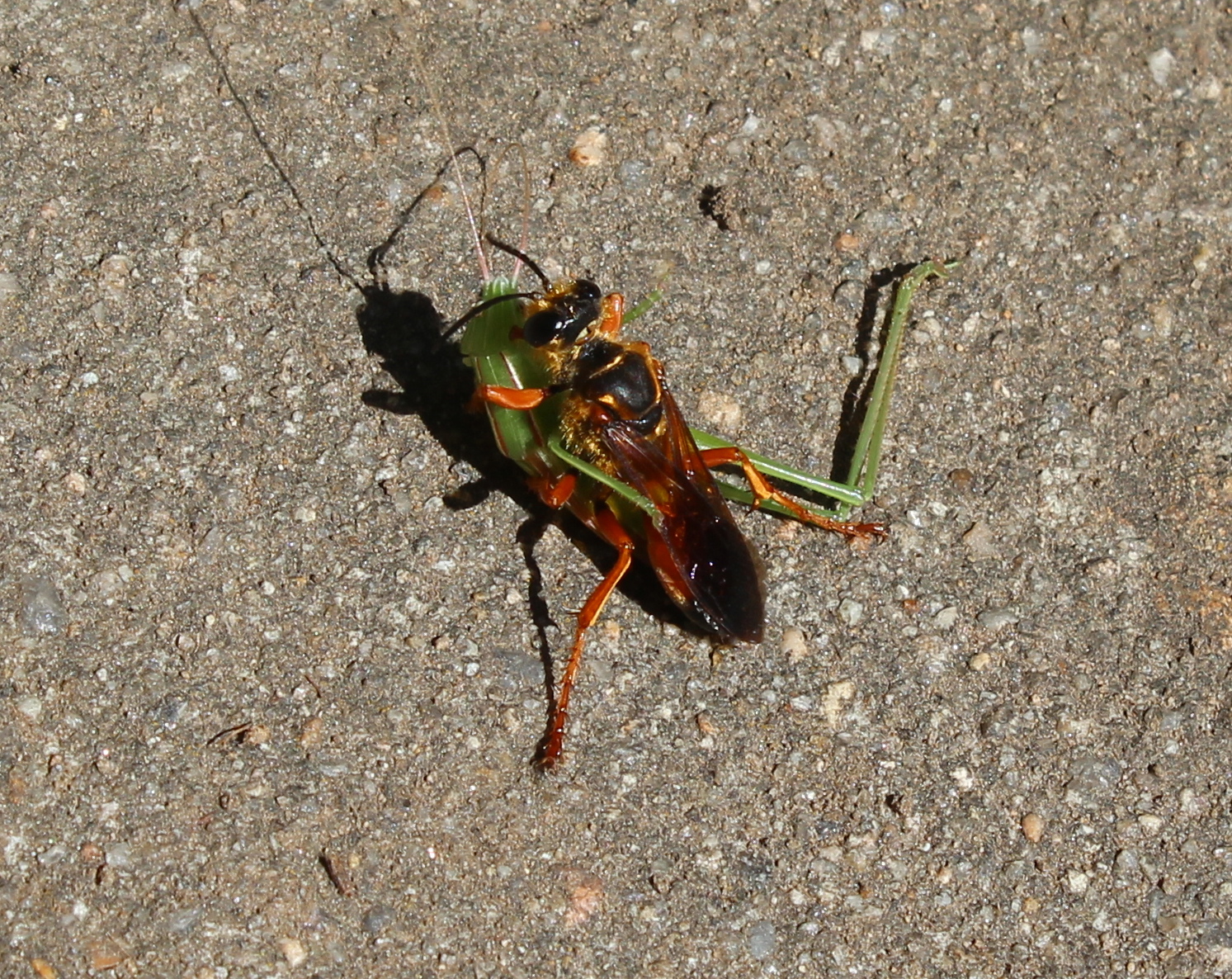
Great Golden Digger Wasp

_

Sphex ichneumoneus 

I was trying to clear back the weeds from our front walk and disturbed a Great Golden Digger wasp who was flying around with a katydid.

She probably has a lair in under the black-eyed-susans and was taking her paralyzed prey down to seal it in a chamber with an egg laid in its chest.


They are not shy and typical of solitary wasps they are not aggressive.  In fact they seem to be curious about people and pets, and often dig their burrows in high-traffic areas.


As a gardener, what's not to like?  They prey on grasshoppers and katydids, they aerate the soil with their burrowing, and they pollinate the flowers.

Thursday, August 1, 2013

Anthropology and the Religion of Progress

_

At the Archdruid Report, John Michael Greer has been taking a close look at what happens when a cultural grand narrative (or secular religion) like Progress begins to lose its grip on a people.  One of his efforts is to show his readers just how integral and foundational this kind of myth is - and how it structures the way we think - even the ways we try to reject, critique, transcend or even just understand the myth itself.

In the 1980’s and 1990’s cultural anthropology went through a kind of dry run for some of what he talks about.  There was a deep and disciplined search for a way to take the science of anthropology out of the Progress trap.  Ultimately, it didn’t succeed, so I’m curious what his take on it is going to be.

Cultural anthropology, specializing as it did in peoples who existed outside the great Western, globalizing myths, was well-positioned to notice the cultural context that contained and constrained our science and our intellectual and philosophical traditions (including cultural anthropology, of course).  Anthropologists noticed two important things, from within a strong habit of self-critique.  The first was the “handmaiden to colonialism” critique, which pointed out that whatever projects anthropologists might have thought they were pursuing, they were first and foremost participants in and collaborators with a globalizing system of extraction and erasure – that would come to control and subsume the cultures being studied.  

The second critique, which crested in the 1990’s I believe, involved the collapse of an intellectual tradition that had contrasted a kind of modern positivism (e.g. anthropologists who could count and point at data) versus a more holistic, romantic rejection of Enlightenment self-congratulation and arrogance.  However, what happened was that this “post-modern” critique, which had come to portray positivism and science as irredeemably blindered by culture and grand narratives, realized that its own critique was also irredeemably blindered by culture and grand narratives.  In one sense it wanted to claim the mantle of intellectual progress as a more honest and clear vision of the world-as-it-was, but was defeated by its own self-examination.

The problem was that we process information (including about the communities and individuals that formed the subjects of cultural anthropology) through narrativization and other forms of cognitive and linguistic sausage-making.  Replacing the modernist narrative (which is what we called the unapologetic embrace of Progress) with a critical narrative served certain useful rhetorical and even occasionally political purposes, but it couldn’t be said to be intellectually honest at its core.  That is, if the goal of science and anthropology was to see the world as it really was – and not how our preferences and prejudices would have it be – how could we possibly claim to have objective knowledge now that we’d shown our methodological tools of participant observation and narrative description to be devices that altered and obscured the world even as we perceived it.  At some point it is just turtles all the way down.

There were several work-arounds to this dilemma.  Probably the most common was to reluctantly set aside such philosophical purities and go out and do the work of anthropology secure in the knowledge that – however flawed and imperfect were the foundations of our science – at least it was better than the various forms of silliness that the political scientists, sociologists and economists were wallowing in.  (To the extent I practiced anthropology, that is where I did it.) This is current business-as-usual cultural anthropology, and it does some pretty good work in my opinion.  Others have tried to grapple with it in other ways.  There is interpretivist anthropology, which acknowledges that cultures, like a piece of literature, can be interpreted, but not explained or understood in some final, definitive way.  There is an effort to create a kind of empty vessel anthropology in which a culture can express itself while being processed as little as possible by an alien anthropologist.  There’s a retreat to positivism, which says that science should focus on those things it can measure or manipulate and leave the rest aside.

The other reaction was a move to "applied anthropology" - which makes use of anthropological knowledge to tackle real-world problems.  There is less room for pristine truth-seeking and more scope for deploying stuff that works - or at least has effects - whether we understand them or not. (Here, too, I count myself as a practitioner.) And here is where I think anthropology and green wizardry (as Greer calls it) intersect.  We are going to transition to a sustainable society - perhaps voluntarily, but more likely because we crash into some non-negotiable limits - and it's hard to see that happening without major revisions to our current religion of Progress.  

Those anthropologists who still study the exotic, study peoples on the margins – who are partially enmeshed in and partially estranged from global culture.  And I think that as Progress begins to fail – as we all become partially estranged from, but remain partially enmeshed in our culture and its great secular religion – that the things that anthropology has learned can contribute to a useful branch of green wizardry.  In my own work I’ve tried to look at the way in which anthropology has already contributed to people trying to change their own psychologies in order to create an ability to live alternatives to “mainstream culture” – as a way of escaping the seemingly inescapable.
_

Tuesday, July 30, 2013

Hummingbird moths in the bergamot

_

My favorite thing about the wild bergamot


is the way it brings in the hummingbird moths.


These moths even mimic the little birds' brashness.

wild bergamot, ox-eye sunflower, phlox and goldenrod
_

Monday, July 29, 2013

Metz Family Reunion

(click on photos to enlarge)

In the 1700's the Browns and Metz's were part of the westward colonization of Pennsylvania.

They settled at the tight end of Big Valley, farming the limestone fields on either side of Saddler's Run, where the long ridges of Jack's mountain and Stone mountain pinch together above the upper Juniata river.

The farms at that end of the valley are still mostly worked by their descendants.

My grandmother's grandfather, Samuel B. Metz was ancestor to many of these.  Most of his 15 children left descendants, and though they have obviously scattered far and wide from the valley, a couple hundred return every year on the last Saturday of July - as they have since the Reunion tradition started over 60 years ago.

They bring a covered dish, eat, fellowship, and stay for the dance.


Em Brown, the hostess
Boys gather on a fence like starlings

T. Ray checks out the grimy paw of great grandnephew, Leo

Susan keeps the tree updated
Dick Brown chats with his old babysitter, Naoma
Girls getting ready for the square dance

Cathleen, Chris, myself and Monica


Bea Brown


Porter

Volleyball happens in the hayfield


The barn dance begins


Scott and Emily Brown's barn, built in 1820, restored in 1919.

Photos by A. Brown and Kim Brown